
Blog

All Cadillac Model Info
2026 Cadillac XT5 on a Rankin County Mississippi road in October morning light

Fall Cadillac Car Care: Questions Pelahatchie Owners Should Ask

In this article Which Model Years Carry the Heaviest Fall Service Priority? Which Model Years Should You Watch Out For? Pros and Cons of Addressing Fall Service in October (vs. Waiting Until December) What Does Fall Actually Demand of Your Cadillac in Central Mississippi? Which Year and Trim for Which Pelahatchie Owner? Ask us what fall maintenance your Cadillac needs, and the truthful answer isn't a universal checklist. It depends on which model year sits in your driveway, and it depends on where you live. Pelahatchie in October isn't suburban Chicago. Your vehicle just came through four or five months of sustained heat, humidity, and air conditioning that ran almost without a break. The fall service question here isn't "prepare for winter." It's "assess the damage summer left behind, and catch any open recall work before the holiday travel season." The short version Mississippi fall means recovering from summer heat load, not prepping for snow. Different question, different checklist. Cadillac's Oil Life Monitor calculates algorithmically and alerts within 600 miles of your next service interval; trust it, but summer heat accelerates degradation, so a check is warranted regardless of the percentage displayed. Tire pressure drops roughly 1 PSI for every 10 degrees Fahrenheit of temperature change, per Cadillac's own guidance. Pelahatchie's swing from a 95-degree August afternoon to a 55-degree October morning is enough to trigger your TPMS light without any actual leak. Model years 2020-2021 of the CT5 and XT5 carry the highest NHTSA recall and complaint volume; 2024 XT5 owners should confirm an airbag module recall is resolved; 2023-2025 XT5 owners should verify an instrument panel illumination recall is complete. A cabin air filter that ran through a full Mississippi summer is saturated. That matters for both defrost performance this fall and air quality now. Schedule your fall service visit before the Thanksgiving travel push. Our current Cadillac XT5 inventory is one place to begin if this fall check points toward a trade, though the more useful first step is reading what your current vehicle's model year tells us about where to focus. Which Model Years Carry the Heaviest Fall Service Priority? Not all Cadillac model years around Pelahatchie reach fall in the same shape, and between NHTSA recall history and documented owner complaint patterns, some years ask for more deliberate attention than others, so the first move is matching your year to its risk profile. What follows is a working guide to where your model year stands. Model Year Range Models Sweet Spot? Documented NHTSA Concerns Fall Priority 2020 CT5, XT5 Watch CT5: 4 recalls, 43 complaints (powertrain, electrical); XT5: highest recall count per NHTSA (5 campaigns) Verify all recalls closed; confirm OLM reset 2021 CT5, Escalade Watch CT5: 4 recalls incl. roof rail side-curtain airbag (21V611000); Escalade: electrical/airbag campaign Confirm airbag recall remedy completed 2022-2023 CT5, XT5, Escalade Moderate CT5 headlight recall (22V903000) affecting 2020-2023 CT4/CT5; XT5 rearview camera (22V709000) 2020-2021; Escalade headlight same campaign Headlight and camera recall check 2023-2025 XT5 Watch Instrument panel fails to illuminate with high beams/signals active (24V459); 6,942 units affected Confirm software remedy applied 2024 XT5 Watch Driver's front airbag cushion may tear during deployment (24V311000); windshield bonding (23V681000) Highest urgency: airbag and windshield recalls 2025-2026 CT5, XT5, Escalade, LYRIQ, OPTIQ, VISTIQ Sweet Spot Complaint volumes significantly lower; 2025 CT5 shows 0 recall campaigns in NHTSA data Standard fall service; confirm OLM status Every recall remedy is performed free of charge by a Cadillac dealer, so the only open question is whether the work is done. A VIN check at nhtsa.gov takes under two minutes, and it tells you definitively whether your vehicle has open campaigns. Which Model Years Should You Watch Out For? The 2020 and 2021 CT5 carry the weight here, accounting for a combined 63 of the 94 total NHTSA complaints logged across the entire CT5 production run through 2026, per NHTSA data compiled by RecallExplained. That concentration matters. It doesn't mean those cars are fundamentally flawed (they aren't), but it does mean a Cadillac technician reading your specific VIN this fall is a more productive use of your time than a generic oil change at a quick-lube. The VIN is the tell. Browse our CT5 inventory if a newer model year is on your radar, but check nhtsa.gov for your VIN first. The 2024 XT5 brings two specific campaigns worth your attention. NHTSA recall 24V311000 involves the driver's front airbag cushion, which may tear during deployment rather than inflating as designed. Recall 23V681000 separately covers windshields that may not have been bonded with the proper urethane sealant. Both remedies are dealer-performed at no cost. For 2023-2025 XT5 owners, recall 24V459 covers an instrument panel that can go dark when high beams or turn signals are active (6,942 units potentially affected). A quick VIN lookup confirms whether your vehicle's software has been updated. Our Escalade inventory reflects the current lineup. Escalade owners in the 2022-2023 range should note that NHTSA recall 22V903000 covered a lighting control module software issue affecting the exterior lighting system. Across the CT5, XT5, and the electric lineup, the 2025 and 2026 model years show markedly lower complaint volumes, and the 2025 CT5 carries zero recall campaigns in NHTSA data as of this writing. These cars still benefit from a fall service visit, though the urgency reads differently. Schedule Your Fall Cadillac Service Check Pros and Cons of Addressing Fall Service in October (vs. Waiting Until December) Pros of Acting Now Cons / Trade-offs Beat the pre-Thanksgiving service backlog Pelahatchie October temps (93 degrees Fahrenheit as of mid-October) mean no cold-weather urgency yet Cabin air filter saturated after full Mississippi summer AC season If your OLM shows 40%+ life, an oil change isn't technically due Recall work is free and appointment availability is better now A November visit catches any additional NHTSA campaigns filed between now and then Tire pressure check is meaningful as morning temps begin dropping TPMS alert may not appear until a cold front arrives Battery load test catches summer heat degradation before any real cold A battery in good shape has no visible symptoms yet The trade-off is straightforward. No mechanical emergency forces a Pelahatchie Cadillac owner into the service bay in October specifically. The case for October is scheduling clarity and thoroughness, and there's no crisis pushing it. You're mostly buying a calm appointment slot and a thorough once-over, and summer is genuinely hard on vehicle systems in this climate, so catching that wear in fall means the vehicle is sorted before holiday travel becomes a factor. What Does Fall Actually Demand of Your Cadillac in Central Mississippi? Fall in central Mississippi asks something different of your Cadillac than the generic checklists assume, because here the season is about recovering from a long, hot summer, and that recovery lands on four systems in particular (oil, tires, cabin filter, and battery). The generic lists miss that part. Oil Life Monitor: what it's actually telling you. Cadillac's Oil Life Monitor doesn't run on a simple mileage clock. The system runs an algorithm that weighs driving conditions, engine load, and operating temperatures. It alerts you within 600 miles of your next service interval, according to Cadillac's published maintenance guidance. A summer of highway commutes between Pelahatchie and Ridgeland, running in high heat with the air conditioning adding engine load, will have burned through oil life faster than the same mileage in cooler months. Between 30 and 50%, you're probably fine through November, but check the date on your last service. Below 30%, schedule service now. The TPMS light and Mississippi temperature swings. Cadillac's tire guidance puts the change at roughly 1 PSI for every 10 degrees Fahrenheit of ambient temperature shift. Pelahatchie's October runs afternoon highs in the low 90s and overnight lows that can fall into the mid-50s on a cold front. A 35-degree swing is a 3-4 PSI drop. Your TPMS light was set at a specific threshold for your trim's recommended pressure (you'll find it on the driver's door placard, not the sidewall). The light coming on at 6 a.m. after a cold front is the system doing its job. It's not a slow leak. Check pressure cold, meaning the vehicle has sat at least three hours, inflate to placard spec, and recheck. Cabin air filter: the most overlooked Mississippi fall item. Your Cadillac ran its climate system in full cooling and dehumidification mode from May through September, and the cabin filter is the first component our Pelahatchie service lane watches load up with the dust and pollen off central Mississippi's rural roads, well before you'd notice it as weaker airflow at the vents. Independent fall-care guidance notes that a heavily loaded cabin filter restricts defrost airflow, which is the first thing you'll feel when the windows start fogging on October mornings. On the Cadillac maintenance schedule, the cabin air filter shows up at 22,500 miles and every 22,500 miles after that. In this climate, though, condition matters more than mileage. Condition beats the odometer here. Battery: summer heat is harder on batteries than cold. Summer heat is tougher on a battery than cold, which runs counter to what a lot of Southern drivers expect. Cold weather reduces a battery's available output (a battery operating at 0 degrees Fahrenheit loses up to 60% of its starting capacity, by Cadillac's service guidance). Sustained summer heat, though, degrades the internal plates and electrolyte chemistry. A battery that's been running the climate system, seat cooling, and infotainment through a Mississippi summer rarely fails dramatically. It just gets weaker. A load test in October tells you where it actually stands. Which Year and Trim for Which Pelahatchie Owner? Your model year determines your fall priority, not just your mileage. Open recall work is free, and it should happen before holiday travel. Driving a 2025 or 2026 Cadillac (XT5, CT5, LYRIQ, OPTIQ, or VISTIQ), your fall checklist is genuinely routine, covering OLM percentage, tire pressure calibration as the overnight lows start dropping, cabin filter condition, and a battery load test. The electric lineup (LYRIQ, OPTIQ, VISTIQ) adds one item. Confirm the 12-volt auxiliary battery, which powers vehicle systems independent of the high-voltage pack, is healthy. Our service team checks that as a standard item. If you're driving a 2022-2024 Cadillac XT5 specifically, the fall visit has a non-negotiable step. Open nhtsa.gov, enter your VIN, and confirm the instrument panel (24V459) and, for 2024 models, the airbag recall (24V311000) are resolved. If not, that work comes first. If you're in a 2020-2021 CT5 or XT5, this fall visit matters more than any other on your ownership calendar. Those years carry concentrated NHTSA complaint and recall activity. Not all of it is catastrophic, but a Cadillac-certified technician reviewing your specific vehicle's VIN against the current recall database is the right move. We do that as part of every service appointment. If you're in an Escalade of any recent vintage, the service picture is cleaner than the sedans and crossovers. The principal 2022-2023 recall (22V903000, exterior lighting software) is a straightforward software update. Beyond that, the Escalade's fall needs mirror the XT5's, with an OLM check, tire pressure, battery load test, and cabin filter. The I-20 corridor runs between Pelahatchie and Ridgeland. For a lot of our clients that corridor is a real commute, and if it's 30 miles each way, your annual mileage is climbing toward the filter and fluid intervals faster than you may expect. Worth knowing going into winter. Frequently Asked Questions What does the Cadillac Oil Life Monitor actually measure, and should I trust it in fall? The Oil Life Monitor runs an algorithm, not a simple dipstick reading. It calculates remaining oil life from engine operating conditions, load, and temperature rather than mileage alone. Cadillac's published maintenance guidance confirms it alerts the driver within 600 miles of the next required service interval. Through a Mississippi summer, sustained high-heat operation and heavy air conditioning load consume oil life faster than the same mileage in cooler conditions. Trust the system, but if you're below 30% and traveling over the holidays, schedule service before you go. Why does my Cadillac's TPMS light come on in fall if there's no leak? Cadillac's tire guidance states that pressure changes approximately 1 PSI for every 10 degrees Fahrenheit of temperature shift. Central Mississippi's fall mornings can land 30-40 degrees below the afternoon highs of August and September. A 30-degree overnight drop works out to a 3-PSI pressure loss, which can bring a tire from properly inflated to below threshold without any puncture or valve issue. Check pressure cold (after the vehicle has sat for at least three hours), inflate to the placard specification on the driver's door jamb, and the light should clear. How do I know if my Cadillac has an open recall that should be addressed this fall? Go to nhtsa.gov and enter your 17-digit VIN in the recall lookup tool. It takes under two minutes and returns every open recall campaign against your specific vehicle. For context, the 2024 XT5 has an open airbag module recall (NHTSA 24V311000), and model years 2023-2025 of the XT5 carry a documented instrument panel illumination campaign (NHTSA 24V459) affecting nearly 7,000 units. Both are remedied free of charge by a Cadillac dealer. Any open recall work should be the first item scheduled, not the last. See What Your Cadillac Is Worth Cadillac of Jackson 700 Adcock St, Ridgeland, MS 39157 (601) 948-5183

2026 Cadillac Escalade ESV rear liftgate open showing cargo area in Ridgeland MS

Cadillac Escalade ESV Space Guide for Larger Households | Ridgeland

In this article Will Everything Actually Fit? Loading and Configuring the Cabin The Honest Tradeoff Job Done The 2026 Cadillac Escalade ESV carries 41.5 cubic feet of cargo behind a fully raised, fully occupied third row, and that one number reframes the whole conversation for a larger household. Everyone stays seated and the gear still fits, at the same time, with nobody folding a row down to make it work. Walk in with this question and you've likely already hit the same tension. The vehicle seats seven or eight, yet once everyone's buckled there's no room left for luggage, sports bags, or anything bulky. The standard Escalade gives you 25.5 cubic feet behind its third row, which is usable. For a household that runs three rows full on a regular basis, though, the ESV's 41.5 cubic feet plays in a different category altogether. What follows is a verified, practical look at what the ESV actually holds, how to set up the cabin for the way your household moves, and where the one genuine tradeoff lives. Will Everything Actually Fit? Yes, with all three rows occupied the 2026 Escalade ESV holds more cargo behind its third row than several midsize three-row SUVs offer with that row folded flat, and the figures below come straight from Cadillac's published specifications. Load or Dimension Cadillac Spec What It Means in Practice Cargo behind 3rd row (all seats up) 41.5 cu ft Four carry-on rollers upright, two large duffels, and a full-size stroller, all at once Cargo behind 2nd row (3rd row folded) 94.1 cu ft A week of luggage for five passengers plus sports gear, cooler, and one oversized item Maximum cargo (both rear rows folded) 142.2 cu ft Near-van capacity; full flat floor for furniture, bike transport, or an extended-trip pack Third-row legroom 36.7 in Comfortable for adults on longer highway runs, not just for kids Third-row headroom 38.2 in No hunching for most adult passengers Third-row shoulder room 62.8 in Three passengers seated without contact Overall length 226.9 in (just under 19 ft) 15 inches longer than the standard Escalade Wheelbase 134 in 13 inches more than the standard model The standard Escalade's third row delivers 34.9 inches of legroom. The ESV's 36.7 inches adds 1.8. On paper that gap sounds minor. Put someone over six feet back there for a drive down to the coast and home again, though, and the difference turns real, and the current generation's cushion geometry also fixed the old knees-up seated position, so adults ride in a natural posture instead of perching. The cargo gap at the rear is the headline. Cadillac lists 41.5 cubic feet behind the third row against 25.5 in the standard body, more than a 60 percent increase. Call it structural rather than incremental. It changes what the vehicle can do for a larger household on any given day. Loading and Configuring the Cabin Browse current Escalade ESV inventory to see available trims and configurations, or look at the standard Escalade if you're still working through which body fits your daily reality. The seating configuration is worth deciding deliberately, before you arrive. The ESV comes standard with second-row captain's chairs, which seat seven. An available 60/40-split second-row bench takes you to eight. Here's how we weigh the choice. Captain's chairs (7-seat) leave a walk-through aisle to the third row. If you're regularly loading children into the back (car seats, boosters, any kid who needs help buckling), go with this. Third-row access is genuinely easy, and the aisle lets you pass things back on a long drive without contortions, bags and snacks and headphones. Small thing. It adds up over distance. Bench seat (8-seat) adds one more passenger in row two and closes the walk-through. Third-row access then means stepping over or folding the bench. If your household runs eight consistently, it's the right call. Run six or seven most days with the occasional eighth, and the captain's chairs serve the majority of trips better. One practical note from loading these at the liftgate. The ESV's independent rear suspension drops the cargo floor compared with older body-on-frame platforms, so the load height is manageable even for heavier items. Hoisting a large cooler or a full duffel in and out doesn't demand the height effort older full-size trucks asked for. The power-folding third row drops at a button press, which earns its keep when both your hands are full. Natchez Trace observation: The Trace runs through Madison County, and households here use it for everything from weekend rides to longer regional trips. The available air ride adaptive suspension self-levels under load, keeping the ESV flat even with the cargo area packed. That composure is what keeps a loaded three-row vehicle settled through sweeping Trace curves rather than leaning through them. [ ] Captain's chairs versus bench, decide on how often you realistically seat all eight, not the theoretical maximum [ ] Measure your largest recurring gear item against the 41.5 cu ft floor footprint before committing [ ] Check the 76.4-inch overall height against your garage door or any covered parking structure you use regularly [ ] Confirm the Trailering Package if you plan to tow, since the ESV is rated at up to 8,000 lbs (RWD, naturally aspirated 6.2L V8, properly equipped) [ ] With car seats involved, walk the third-row access with the actual seat installed before you choose bench or captain's chairs The Honest Tradeoff The one genuine tradeoff is size, plainly stated, because the Escalade ESV runs 226.9 inches long with a turning circle of 43.3 feet in diameter per Cadillac's specifications, and in the Northpark parking deck or a compressed school carpool line that length becomes a real factor we won't frame otherwise. Explore financing options when you're ready to move forward. For households that park at home in a standard double garage and spend most of their miles on I-55 or I-220, the length rarely shows up as a daily problem. The cameras and parking sensors manage the rearward geometry well in close quarters, and the ESV moves with real authority at highway speed. If your regular parking is a tight structure, a narrow urban block, or a garage that already fits your current vehicle snugly, the 43.3-foot turning circle deserves straight attention before you decide. The standard Escalade, at 211.9 inches, is the right answer for households that want three-row capability in a more manageable footprint. For households that run three rows full on a regular basis and need a real cargo hold behind the last row, the ESV's case is simple. The numbers make it, not the marketing language. Explore Financing Options Job Done The 2026 Cadillac Escalade ESV holds 41.5 cubic feet behind an occupied third row, seats up to eight, and tows up to 8,000 pounds when properly equipped with the Trailering Package, while the third row seats adults in a natural posture on 36.7 inches of legroom and the maximum cargo volume with both rear rows folded reaches 142.2 cubic feet. For larger households in Ridgeland, Madison, and Brandon who run three rows full and still need real cargo capacity, the ESV settles the central tension of three-row SUV ownership without asking anyone to swap a seat for their luggage. The tradeoff is a 43.3-foot turning circle and a 227-inch footprint. That's the picture, drawn straight. Our team is at 700 Adcock St in Ridgeland when you're ready to walk through the configuration in person. By the Cadillac of Jackson Team | October 2026 Get Your Trade-In Value Cadillac of Jackson 700 Adcock St, Ridgeland, MS 39157 (601) 948-5183
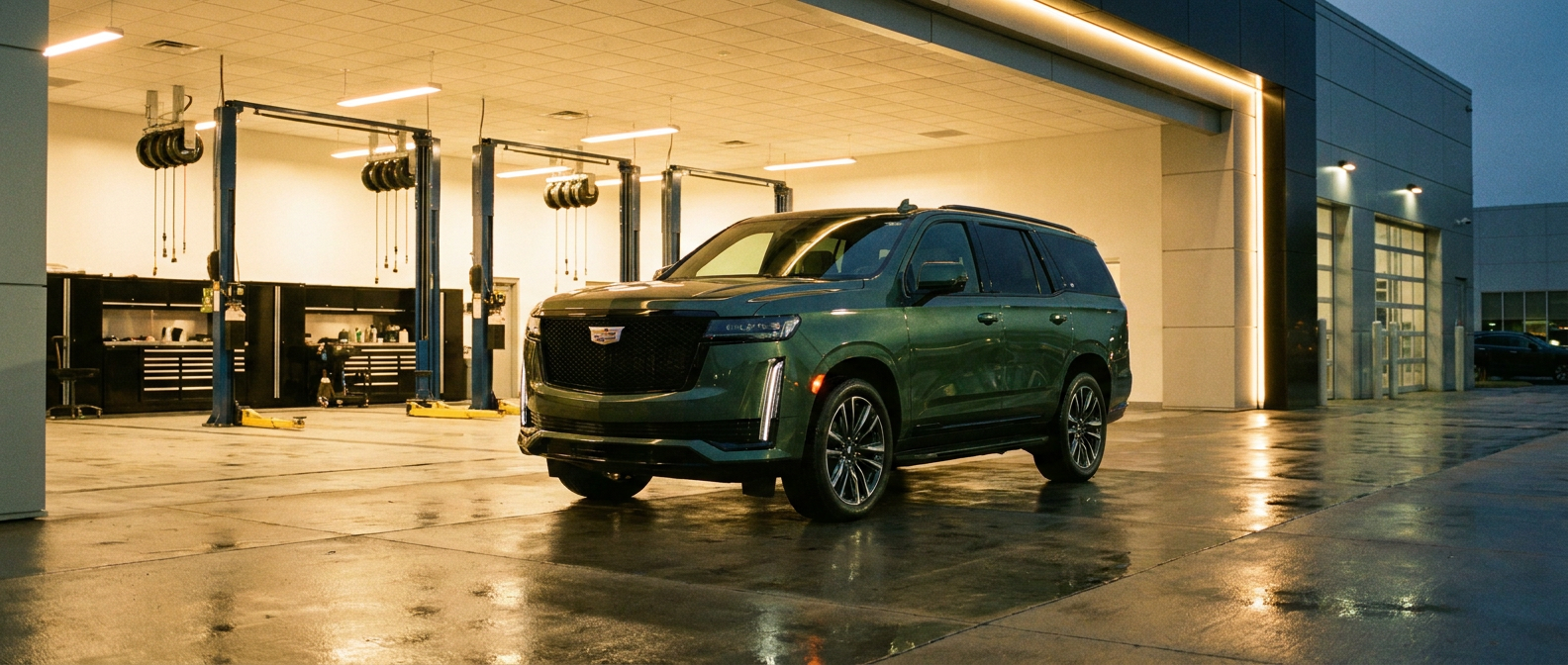
2026 Cadillac Escalade in dealership service bay at Cadillac of Jackson in Ridgeland MS before holiday travel

Schedule Cadillac Service Before the Holidays | Ridgeland, MS

In this article What's the Plan at a Glance? Why the Holiday Window Is Tighter Than You Think How the Oil Life System Actually Works, and What It Doesn't Tell You What Changes for the LYRIQ and Other Electric Models The Road You're Actually Driving The single move that protects a holiday road trip is a Cadillac service appointment finished at least two weeks before you travel. Give yourself that window. Any tighter and you're competing with every other family in the metro who also remembered at the last minute. The Escalade and the rest of the lineup are built to cover serious mileage without drama, and that engineering relies on service intervals being met on schedule rather than approximated. So you'll want a few things straight before you call us. What's the Plan at a Glance? Step What to do Best time to act Notes Book your appointment Call or schedule online 2-3 weeks before Thanksgiving week Service lanes fill in early November Pull your Oil Life percentage Check the instrument cluster display Before you call Tells us exactly where you are in the interval Note any dashboard alerts Write down any active messages Same day you check oil life Cabin air, tire pressure, brake alerts all count Confirm your transportation plan Wait, shuttle, or loaner When you book Let us coordinate timing properly Post-service reset check Verify Oil Life System resets to 100% Before you leave the lane A missed reset means a false reading on your next trip Why the Holiday Window Is Tighter Than You Think Our service lane sees a genuine compression every year in the weeks before Thanksgiving, and the compression is reliable rather than theoretical. Appointments that'd normally turn in two or three days stretch closer to a week once the whole metro's trying to get road-ready at the same moment. Two to three weeks of lead time is what gets you a same-week slot instead of a scramble. Book your appointment online now, before the first week of November. We'll give you that advice straight. Insider note: If your Oil Life percentage is anywhere below 30%, book immediately. Cadillac's Oil Life System alerts you within 600 miles of service being due, per the owner's manual, and "within 600 miles" during a Thanksgiving run to New Orleans (186 miles each way on I-55) is not a comfortable margin. How the Oil Life System Actually Works, and What It Doesn't Tell You The GM Oil Life System on every gas-powered Cadillac (the CT5, the XT5, the Escalade and Escalade ESV) does not count odometer miles, which throws people who expect a simple mileage countdown. It runs an algorithm that weighs engine temperature, RPM, trip length, and idle time to estimate how much useful life remains in the oil. Cadillac's published maintenance guidance specifies a hard 12-month cap regardless of the percentage displayed. Meaning a low-mileage vehicle driven mostly on short Madison-to-Ridgeland commutes can reach its annual limit before the display shows any concern. The short-trip effect is the piece that slips past easily. The oil ages. Short trips wear it down faster than the odometer ever suggests. Cadillac mandates a 12-month oil change maximum even if the Oil Life System percentage hasn't reached zero. Short-trip driving around the Jackson metro accelerates oil degradation faster than the odometer alone indicates. The system also doesn't flag your brake fluid condition, cabin air filter state, or tire tread depth on its own. Those have their own intervals. On a 2026 Escalade, the Cadillac owner's manual calls for a cabin air filter inspection around 22,500 miles and an evaporative control system check at 45,000. Neither appears on the instrument cluster countdown. When you come in before the holidays, our team checks the full picture, not just what the alert triggered. The system also won't reset itself. The Oil Life System must be manually reset at every service. If you've had work done elsewhere and that reset was missed, your display is reading stale data. Worth confirming with us before you leave. What Changes for the LYRIQ and Other Electric Models The LYRIQ, OPTIQ, and ESCALADE IQ carry no Oil Life System, because there's no combustion engine, so the oil-change rhythm drops out of the calendar entirely. The simplification is genuine. But no oil change does not mean no pre-trip service. Before a holiday run, an electric Cadillac benefits from a multi-point inspection that covers tire condition and inflation (range and handling both respond to pressure), brake system health (regenerative braking reduces pad wear, but the hydraulic system still needs attention), cabin air filter condition, and a software update check. Cadillac's Certified Service technicians are trained on the full electric architecture. We wouldn't hand that to a general shop that's never seen the high-voltage system. Schedule Your Pre-Holiday Service Appointment The Road You're Actually Driving A pre-trip inspection matters most here because of where we sit, and the route you pick for the holidays decides how hard the drivetrain actually works. Ridgeland sits at the I-55 and I-220 interchange. The interchange puts our buyers at the spine of every major holiday route in the metro. I-55 south carries you to New Orleans in roughly 186 miles. I-55 north runs toward Memphis. I-20 west toward Vicksburg. The Escalade family handles all of it without complaint when it's properly maintained, and it struggles when it isn't. We see a pattern on post-holiday return appointments. Vehicles that went out borderline on tires or brakes come back with a problem a pre-trip inspection would have caught. The professional class this community is made of travels often and travels far, so an inspection before that first long run is simply the more composed choice. If your Cadillac is due for service, or close enough that the holidays will push it past the annual limit, now is the time to act. Don't let the calendar make the decision. Reserve Your Service Appointment Cadillac of Jackson 700 Adcock St, Ridgeland, MS 39157 (601) 948-5183
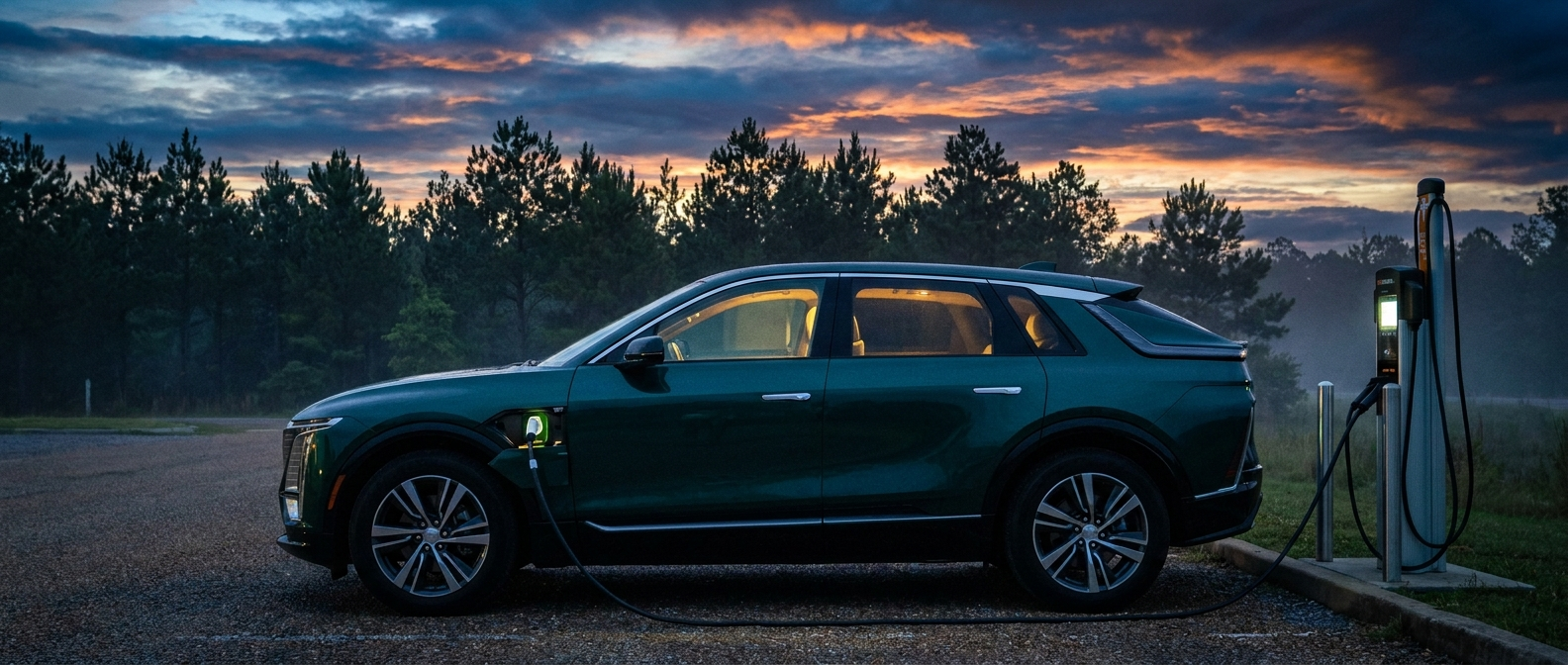
2027 Cadillac LYRIQ charging at a public EV station in Ridgeland, Mississippi at dusk

Cadillac EV Charging and Battery Questions: Ridgeland, MS Owner Guide

The Cadillac LYRIQ carries an EPA-estimated 326 miles of range in rear-wheel drive, and that's a substantial number by any measure. Drive it through the Jackson metro in July, though, with the climate system working hard and no Level 2 charger installed at home yet, and your daily reality will sit a fair bit below that EPA figure. We wrote this for the questions buyers in Ridgeland, Madison, and Brandon actually bring to us, covering what range is realistic here, where you charge, and how you build a routine that makes ownership easy. How Far Will a Cadillac EV Really Go in Mississippi? The EPA range figures are accurate, measured under standardized conditions, and they hold up as a baseline, but what moves them in the real world here is the continuous load of air conditioning through a Mississippi summer, which runs off the same pack that turns the wheels. Count on that draw being constant. Model Drivetrain EPA-Estimated Range DC Fast Charge Rate Level 2 (19.2 kW) 2027 LYRIQ RWD Single motor 326 mi 190 kW (up to 86 mi in 10 min) Up to 50 mi/hr 2027 LYRIQ AWD Dual motor 319 mi 190 kW (up to 86 mi in 10 min) Up to 50 mi/hr 2027 OPTIQ RWD Single motor 317 mi 150 kW (up to 79 mi in 10 min) Up to 50 mi/hr 2027 OPTIQ AWD Dual motor 303 mi 150 kW Up to 50 mi/hr 2027 VISTIQ AWD Dual motor 305 mi 190 kW (up to 80 mi in 10 min) Up to 47 mi/hr 2027 ESCALADE IQ AWD Dual motor 465 mi (Cadillac-est.) 350 kW (up to 117 mi in 10 min) Up to 36 mi/hr (std.) *All range figures are EPA-estimated except the ESCALADE IQ, which carries a Cadillac-estimated range. The ESCALADE IQ is over the weight threshold for mandatory EPA fuel-economy labeling.* Air conditioning pulls continuous power from the same battery that moves the car, and in sustained summer heat that draw never lets up. A reasonable planning figure for warm-weather mixed driving is roughly 10 to 15 percent below the EPA estimate. So a 326-mile vehicle becomes a practical 275-to-290-mile vehicle on a hot August day, cabin pre-cooled from home and the AC holding comfort on the road. Still, that's plenty for any commute in this market, and it's the honest starting point for planning a run to Memphis, New Orleans, or the Gulf Coast. One thing that barely registers on range here is cold-weather battery conditioning. Mississippi winters rarely challenge lithium-ion chemistry the way northern climates do. In this state the thermal concern runs the other way, toward keeping the pack cool during long DC fast-charge sessions in August. On a car that's sat baking on our Ridgeland lot all afternoon, the first few minutes of a fast-charge session can go toward cooling the pack before acceptance climbs, and the LYRIQ and VISTIQ thermal management systems are built to handle exactly that. Where Do You Charge in the Ridgeland and Jackson Area? The charging network across the Ridgeland and Jackson area is smaller than what you'd know from a major metro, so if you've owned an EV in Atlanta or Dallas, you'll notice fewer public stations than you're used to, though planning around that reality turns it into a non-issue. Most of the work happens at home anyway. Our service team at 700 Adcock Street in Ridgeland keeps a 50 kW CCS2 charger on-site, handy for a top-up while you're in for service. For quicker public charging, Renaissance at Colony Park on Highland Colony Parkway in Ridgeland runs DC fast chargers rated to 125 kW output, two ports, open to the public. Pearl's Bass Pro Drive Tesla Supercharger (150 kW, public) sits well for drivers heading east or coming back from the coast, and it's the cleanest stop if you've got the OPTIQ or VISTIQ out on a longer run, since both carry native NACS ports and connect to Tesla Superchargers without an adapter. LYRIQ and ESCALADE IQ use a CCS1 charge port instead. A GM-approved NACS adapter opens the Tesla Supercharger network to them, though it's a separate item you'll want to confirm and keep in the vehicle before a long trip. That's the practical split in the lineup right now, and it's worth knowing before you route a Memphis weekend. Where should charging start? At home, and it's where we steer almost every buyer first. A professionally installed 19.2 kW Level 2 wall charger recovers up to 50 miles of range per hour on the LYRIQ. Plug in when you get home and by morning the battery is full, no public charger in your week at all. ESCALADE IQ owners get about 22 miles per hour from the standard 11.5 kW onboard charger; the available 19.2 kW unit raises that to about 36 miles per hour. Charging note for longer trips: DC fast charging runs most efficiently below 80 percent state of charge. The LYRIQ's thermal management system preconditions the battery on its own once you navigate to a fast charger. Turn that on before you arrive to get peak charge acceptance and trim your stop time. The OPTIQ's native NACS port and 150 kW DC fast-charge capability make it the most plug-and-go choice in the lineup for drivers who travel often and want the simplest access to the broadest charging network in the state. Home Level 2 charging eliminates most public-charger dependence for daily driving Native NACS port (OPTIQ, VISTIQ) connects to Tesla Superchargers without an adapter LYRIQ and ESCALADE IQ use CCS1; a GM-approved NACS adapter unlocks Supercharger access Renaissance at Colony Park in Ridgeland offers 125 kW public DC fast charging The Pearl Supercharger (Bass Pro Drive) is the practical fast stop for eastbound and southbound routes Plan Your Cadillac EV Ownership This Way The owners who make EV life feel effortless around here tend to follow one simple pattern, installing a home charger, setting the charge limit to 80 percent for everyday use (the battery's preferred long-term operating range), and saving 100 percent charges for the days they know they'll need the full distance. That rhythm, paired with the LYRIQ and VISTIQ range figures, covers nearly every commute and most regional travel here without a second thought. For the ESCALADE IQ, the calculus gets even more relaxed. Cadillac estimates up to 465 miles on a full charge, and the 350 kW peak DC fast-charge capability means that on the rare stop you do make, it's roughly 117 miles of range in about 10 minutes at a compatible high-power charger. Here's the honest tradeoff. Finding a 350 kW charger in Mississippi today takes planning, and the infrastructure will expand, but right now that figure matters more for Interstate travel than for a daily Ridgeland-to-downtown loop. The VISTIQ sits in a different spot. It's the three-row family hauler in the electric lineup, EPA-estimated at 305 miles with the standard 11.5 kW onboard charger, and it takes up to 190 kW at a public DC fast charger, good for about 80 miles in 10 minutes. For a family in Madison or Brandon juggling school, practice, and weekend travel, the home-charge routine handles the week. A regional trip to the Gulf Coast works fine with one planned stop. We'll say this plainly. If you're not ready to install a home charger, you'll work harder to live with a Cadillac EV in this market than an owner who has one. The public network here is functional and growing, though it still isn't as dense as what you'd find in Atlanta or Dallas. For buyers willing to make the one-time home installation, and the professional class in Ridgeland and Madison usually has what it takes to do it, the daily routine gets genuinely low-friction. Plug in, sleep, drive. Frequently Asked Questions Does Mississippi heat reduce my Cadillac EV's range? Yes, and the mechanism is worth understanding. Air conditioning draws power from the traction battery, not a separate system, so in sustained summer driving that continuous climate load trims real-world range by about 10 to 15 percent against the EPA estimate. The EPA cycle is standardized and doesn't replicate a 98-degree commute on I-55 with the cabin cooled to 68 degrees. A practical planning range for the 2027 LYRIQ RWD in warm-weather mixed driving lands around 275 to 290 miles. You can claw back some of that margin by pre-conditioning the cabin while still plugged in at home. The car cools before it disconnects from grid power, so you start the drive full and already comfortable. Should I charge my Cadillac EV to 100 percent every night? For routine daily driving, an 80 percent charge limit serves most owners well. Cadillac's battery management system recommends it for long-term capacity preservation, since lithium-ion chemistry operates most efficiently when it isn't held at full charge for long stretches. Every Cadillac EV lets you set that limit straight from the vehicle's settings menu or the myCadillac app. Reserve 100 percent charges for days when your route genuinely needs the full range. Around the Jackson metro, a partial charge covers most commutes. What connector does my Cadillac EV use, and does it work at Tesla Superchargers? The 2027 OPTIQ and 2027 VISTIQ come with a native NACS (North American Charging Standard) port that connects directly to Tesla Superchargers and the growing network of NACS-compatible public stations without an adapter. The 2027 LYRIQ and 2027 ESCALADE IQ use a CCS1 port instead, and a GM-approved NACS adapter opens Supercharger access for them. Confirm you've got it in the car before a longer trip. All four models also support Level 1 and Level 2 AC charging at home. *By the Cadillac of Jackson Team | October 2026* Schedule a Service Appointment Cadillac of Jackson 700 Adcock St, Ridgeland, MS 39157 (601) 948-5183

2026 Cadillac XT5 on a tree-lined boulevard in Madison, MS on a warm October afternoon

Choosing a Cadillac for Everyday Trips Around Madison, MS

In this article Why Does Each Cadillac Fit Madison Differently? The XT5 Remains the Most Versatile Daily Driver in This Market The Electric Lineup Is a Serious Conversation, Not a Novelty On a Day That Starts With Rain Before 8 a.m. The I-55 corridor between Ridgeland and Gluckstadt is carrying roughly 70,000 vehicles a day right now, and with the 2026 lane-widening construction reshaping that stretch, stop-and-go has become the daily texture of the commute rather than a rush-hour inconvenience. Add October humidity that still registers a heat index near 100 degrees Fahrenheit by midday, afternoon thunderstorms that arrive without ceremony, and the particular mix of tight parking decks and wide suburban corridors that define this market, and you have a set of real, specific demands on any vehicle you plan to drive every day. The right Cadillac for Madison isn't simply the one with the longest spec sheet. It's the one whose features align with what this commute, this heat, and this road actually require. For everyday Madison driving, the 2026 XT5 is the most balanced fit across cargo, comfort, and I-55 stop-and-go. The 2026 OPTIQ earns serious consideration if you charge at home. Its EPA-estimated 317-mile range covers a week of north metro errands on a single overnight charge. Browse the 2026 Cadillac XT5 on our lot Why Does Each Cadillac Fit Madison Differently? Not every vehicle fits every part of the Madison commute equally, and the useful way to sort them is to set the conditions of this specific market, heat and rain and construction and parking decks, beside the features built to handle each one. The table below does that work. Local Condition or Use The Feature That Handles It Why It Matters Here I-55 construction stop-and-go, lane shifts Super Cruise hands-free driver assistance (standard on LYRIQ, OPTIQ Sport+, CT5) Reduces cognitive fatigue on a corridor with constant merge decisions and sudden braking Heat index near 100 degrees Fahrenheit in a parked cabin Ventilated and cooled front seats A Mississippi parking lot in October still bakes a leather seat; ventilated seats cool on contact, not after five minutes of A/C Afternoon thunderstorm visibility HD Surround Vision, Automatic Emergency Braking, LED lighting Reduced visibility in heavy rain is precisely when active safety systems earn their keep Madison to Jackson medical or legal district commute (~12-15 miles, mostly I-55) EV range of 300+ miles (LYRIQ, OPTIQ, VISTIQ) A round-trip that never taxes a charge; one overnight session covers the week Parking decks at Baptist Medical Center, Colony Park, Highland Village Surround-view cameras, park assist Tight turns and low-ceilinged decks reward a tight camera system over guesswork Weekend runs to Brandon or the Reservoir Cargo volume: XT5 (63 cu. ft. with rear seats folded), VISTIQ (80.2 cu. ft. behind first row) Enough room for a weekend's worth of gear without rethinking the trip The XT5 Remains the Most Versatile Daily Driver in This Market The 2026 XT5 earns its spot as Madison's most versatile daily driver even while we name the tradeoff up front, because it's the final iteration of a first-generation design that Cadillac is replacing for 2027. The 8-inch touchscreen is genuinely small by current standards, and the interior architecture shows its age next to the LYRIQ's 33-inch Horizon Display. Those are real concessions. See the 2026 Cadillac CT5 sedan For Madison's daily pattern, the XT5 still does the fundamentals exceptionally well. It seats five with genuine rear legroom (39 inches), folds to 63 cubic feet of cargo space per Cadillac's own figures, and the turbocharged 2.0-liter four-cylinder returns an EPA-estimated 22 city and 29 highway on the base FWD configuration. That 29-highway number matters when you're running 55 north toward Ridgeland every morning rather than grinding through midtown. The AWD variant (EPA-estimated 21 city / 27 highway) makes sense if your work takes you across the reservoir roads in winter, but for most north-metro professionals, FWD is the rational choice here. The Premium Luxury trim adds a surround-view camera, automated parking assist, and a head-up display, all now standard for 2026 without a separate package fee. That combination pays off in Colony Park's multilevel parking structure and in the Baptist Medical Center campus garage, where ceiling clearance and tight turning radii are the actual problem. On our lot we steer drivers toward that surround-view setup for exactly those decks, where a low ceiling and a tight ramp turn make the camera worth more than any guesswork. Explore the 2026 Cadillac LYRIQ Cadillac lists the 2026 XT5's maximum cargo volume at 63 cubic feet with rear seats folded and front-row legroom at 41.2 inches. Both figures reflect the current model year. The Electric Lineup Is a Serious Conversation, Not a Novelty The LYRIQ and OPTIQ have crossed a threshold that makes them genuinely practical for Madison's daily commute, and we think this market reads that shift clearly rather than treating it as a gimmick. A north metro professional driving from Madison or Ridgeland to a Jackson office or hospital campus covers roughly 12 to 15 miles each way. The 2026 LYRIQ carries an EPA-estimated 326 miles of range on RWD; the 2026 OPTIQ reaches 317 miles on its standard single-motor RWD configuration. Neither of those ranges gets stressed by a week of Madison errands and I-55 commuting. You'd refuel at home, overnight, and never visit a public charging station unless you're making a run to New Orleans. The OPTIQ earns particular attention in 2026 because it's now a meaningfully different vehicle from its 2025 version. Cadillac has replaced the dual-motor setup with a standard single-motor rear-wheel-drive configuration producing 315 horsepower, with the dual-motor AWD (440 horsepower, 303 miles of EPA-estimated range) as an available option. The 33-inch Horizon Display is standard across the lineup, as is Google built-in compatibility. If you drive solo five days a week and charge in a private garage, the OPTIQ's footprint (smaller than the LYRIQ, with an EPA-estimated 317-mile range) fits the Madison commute cleanly. The VISTIQ sits above both in scale and capability, with an EPA-estimated 305 miles of range, 80.2 cubic feet of maximum cargo space behind the first row, and standard dual-motor AWD producing 615 horsepower. For a household that replaced a three-row SUV with something electrified, this is the vehicle that makes that trade feel considered rather than compromised. Explore Financing Options On a Day That Starts With Rain Before 8 a.m. Madison's afternoons bring thunderstorms more days than not through most of the year, and October is no exception, so the practical question is how a vehicle behaves in reduced visibility on a construction-active corridor where lane markings shift and merge distances compress. The answer lives in the hardware. The cabin and safety architecture of the current Cadillac lineup separates from the prior generation in a way you can feel on a wet morning. Automatic Emergency Braking is standard across every 2026 model in the lineup. Lane Keep Assist with Lane Departure Warning comes standard on the XT5. The CT5 (Cadillac's sport sedan, with a base 2.0-liter producing 237 horsepower and an EPA-estimated 22 city / 31 highway on RWD) adds Super Cruise as standard equipment, the hands-free driver assistance system that handles the maintained map segments of I-55. Driving from Madison toward the I-220 interchange in conditions where you'd rather be watching the car in front than managing your lane position is exactly the use case Super Cruise was built for. Keep your Cadillac's safety systems current with a service appointment The CT5 makes the most sense for drivers who want a sedan and want it to handle. Its rear-wheel-drive character, tight turning circle, and cabin quiet reward a commuter who values the drive itself. The tradeoff is plain. With 11.9 cubic feet of trunk space, you're not loading it for a weekend run, so it stays a commuter's sedan with a composed ride rather than a cargo solution. Get a Trade-In Appraisal Cadillac of Jackson 700 Adcock St, Ridgeland, MS 39157 (601) 948-5183

2026 Cadillac XT5 parked at Cadillac of Jackson dealership in Ridgeland, MS on a clear afternoon

What Cadillac Service Records Actually Tell You When Buying Pre-Owned

In this article How Do Service Records Actually Work on a Used Cadillac? Which Layer Matters Most for a Pre-Owned Cadillac Buyer in Ridgeland? Key Terms Worth Knowing Before You Walk In What This Means When You're Ready to Buy Shopping for a pre-owned Cadillac around Ridgeland, a fair first move is to ask for the CARFAX. Reasonable enough. It's also only one layer of a three-layer document, and it happens to be the least complete of the three. Knowing what each layer covers, what it quietly leaves out, and why those gaps matter in this particular climate is what separates a confident purchase from an expensive lesson you learn two summers later. The Cadillac XT5 is one of the more common pre-owned Cadillacs we see roll through our lot, and the question that tends to follow a buyer onto the lot isn't about trim levels. What a buyer really wants to know is what the paperwork actually means. A vehicle history report shows you what was reported voluntarily. A GM dealer's service-history pull shows you what was actually done at any GM facility. Physical inspection shows you what neither document captured. You need all three. How Do Service Records Actually Work on a Used Cadillac? Service records on a pre-owned Cadillac aren't a single document at all; they're three overlapping sources that frequently disagree with each other, and learning to read all three against one another is the whole skill, because any single layer on its own will leave you confident about the wrong things. Getting comfortable with each one is the point. Layer one, the vehicle history report. CARFAX and AutoCheck pull their data from state agencies, insurance carriers, and the repair facilities that opt into their reporting network. For most maintenance work, reporting is voluntary. An independent shop that changed the oil at 35,000 miles might have reported it to CARFAX automatically through its shop-management software, or it might not have. A gap in reported maintenance doesn't mean the maintenance never happened. It means the facility either skipped reporting or sat outside the network. On title events, branded titles (salvage, flood), and insurance-reported accidents, these reports are authoritative. As a complete maintenance ledger, they're unreliable. Layer two, the GM dealer service history pull. Buyers overlook this layer easily, and our team treats it as non-negotiable. Any GM-brand service department can run a VIN through the dealer service system and retrieve every authorized GM repair, recall completion, and authorized maintenance performed at any GM dealership across the network, well beyond the store you happen to be standing in. If a previous owner had their XT5 serviced at a Chevrolet dealer three states away, that work shows up here. The CARFAX may show nothing at all for the same stretch of months. The two reports cover different universes of data. Layer three, the physical inspection. The GM service history records what technicians entered. It doesn't record what they might have missed, or what a previous owner quietly deferred. A physical inspection of the wear items (brake rotor thickness, tire tread depth and wear pattern, coolant condition, cabin air filter condition) closes the documentation loop with something you can actually measure. Source What it covers well What it misses CARFAX / AutoCheck Title events, branded titles, insurance accidents Maintenance at non-reporting shops, unreported incidents GM dealer VIS history pull Authorized GM repairs, recalls, all GM-network service Private shop maintenance, work entered incorrectly Physical inspection Current wear item condition History of prior ownership behavior Which Layer Matters Most for a Pre-Owned Cadillac Buyer in Ridgeland? All three matter together, though if the Cadillac you're eyeing spent any meaningful time in central Mississippi's climate, the physical inspection carries weight that shoppers in cooler, drier markets never have to account for the same way, and the reason has everything to do with heat and the rubber it slowly cooks. Mississippi runs some of the most sustained ambient heat in the continental United States. Ridgeland and Madison regularly see days above 95 degrees Fahrenheit from June through mid-September, and the humidity amplifies everything heat does to rubber and elastomer components. Coolant hoses, HVAC evaporator cores, door seals, and suspension bushings all age differently in that environment than the same parts would in a vehicle that spent its life somewhere temperate and northern. When our team goes through a pre-owned Cadillac that's lived in this market, we look hard at coolant condition (color, consistency, and any sign of contamination), at the serpentine and accessory belts, and at how cold the HVAC blows at first startup on a hot afternoon. A car can carry a complete GM service history pull and still arrive with a heat-stressed cooling system. Both things are true at once. The records tell you what was done; the inspection tells you what the climate asked of the car between service visits. Browse our current pre-owned inventory and explore the Cadillac CT5 if you'd like to see specific vehicles where our team has already run this process before the car ever reached the floor. Schedule a Pre-Purchase Inspection Key Terms Worth Knowing Before You Walk In Term What it means in plain language VIS pull (GM Vehicle Information System) A dealer service-department report showing all GM-network authorized repairs, recall history, and service history tied to a VIN Branded title A legal designation (salvage, flood, rebuilt) that follows the vehicle permanently through state titling records Open recall A safety or compliance recall issued by the manufacturer that hasn't been completed on that specific vehicle. Ask for this specifically, as it's free to complete at any Cadillac dealer CPO (Certified Pre-Owned) A manufacturer-backed designation requiring the vehicle to pass a 172-point inspection and meet eligibility requirements. Cadillac's program requires the vehicle to be within four model years and under 50,000 miles Wear items Components expected to be replaced through normal use: brake pads and rotors, tires, filters, belts, wiper blades What This Means When You're Ready to Buy We'll be direct about this one. A pre-owned Cadillac bought without the GM service history pull is a car you're buying on partial information, and while the CARFAX earns its place in the folder, it simply can't stand in for the dealer pull that documents the GM-network side of the story. The CARFAX is useful, but it won't do the job alone. Ask any Cadillac or GM service department to run the VIN before you sign. That request costs you nothing and hands you the one document CARFAX genuinely can't replicate. The honest tradeoff on Certified Pre-Owned runs like this. Cadillac's CPO program adds the 172-point inspection and holds vehicles to eligibility requirements (within four model years, under 50,000 miles at the time of certification), which means plenty of well-kept pre-owned Cadillacs with higher mileage or a longer service history simply won't qualify, and that says nothing about their condition. Some of the most mechanically sound used cars on a lot just miss the CPO window. A thorough inspection of a non-CPO car with a clean GM service history pull can tell you more than a CPO badge sitting on a vehicle with thin documentation. Before any pre-owned vehicle reaches the floor at Cadillac of Jackson, our team runs the VIS, reviews the vehicle history report, and puts the car through our own multi-point inspection. Our service department handles the cars we sell the same way it handles the ones our existing customers bring in for scheduled maintenance, the same technicians, the same standards. You can schedule service for any pre-owned Cadillac you've already bought, or one you're still weighing, and we'll walk through the inspection results with you. Frequently Asked Questions Can a Cadillac dealer pull service records for a vehicle that was serviced somewhere else? Yes, with one important distinction. Any GM dealer's service department can access the GM-network service history for a vehicle through its VIN, which captures authorized GM repairs, recall completions, and maintenance performed at any GM-affiliated dealership (Cadillac, Chevrolet, Buick, GMC). Work done at independent shops, non-GM dealers, or quick-lube places outside the GM network won't show up in that system. CARFAX may or may not capture it separately, depending on whether that shop reports to CARFAX voluntarily. A clean GM service history pull and a separate CARFAX are both worth requesting, not just one of them. Is a Cadillac CPO vehicle always a better choice than a regular pre-owned? Not automatically. Cadillac's CPO program requires vehicles to be within four model years and have fewer than 50,000 miles to qualify. A vehicle outside that window (say, a six-year-old Escalade with 60,000 documented miles and a clean GM service history) wears no CPO badge yet can carry strong documented history. The inspection and the records matter more than the certification label by itself. For a car that qualifies, the CPO designation brings manufacturer-backed program benefits. For one that misses on age or mileage alone, a thorough independent review of the documentation and the vehicle's physical condition is the functional equivalent. Explore Financing Options Cadillac of Jackson 700 Adcock St, Ridgeland, MS 39157 (601) 948-5183

2026 Cadillac XT5 on a tree-lined scenic road near Clinton, Mississippi in fall

Weekend Drive Prep Checklist: Your Cadillac from Clinton

A weekend drive out of Clinton is one of the better calls you can make in October. The 2026 XT5 picks up the Natchez Trace Parkway at Milepost 89, right at the end of Pinehaven Road, and the 2026 CT5 was built for exactly the composed, unhurried two-lane run the Trace demands at its 50 mph pace. There's a tradeoff worth naming. A Cadillac's engineering is at its best when its systems are set properly before you leave the driveway, and skipping that step undermines everything the car does well. We've listed what to check the evening before. What Goes on the Checklist? Below is the complete, print-and-take-it-with-you list, the one you can run the evening before with nothing more than a tire gauge, a few minutes of daylight, and maybe a helper to watch the lights. The section that follows explains the reasoning behind each item. Before You Leave the Driveway [ ] Tire pressure confirmed cold, against the door-jamb placard (not the tire sidewall) [ ] Tread depth checked (quarter test: if the top of Washington's head is visible in any groove, it's time to replace) [ ] Spare tire or temporary mobility kit confirmed present and inflated [ ] Engine oil life monitor checked in the driver information center [ ] Coolant reservoir at the correct fill line (cold, cap closed) [ ] Brake fluid reservoir level confirmed within range [ ] Windshield washer fluid topped off [ ] Wiper blades cleared of debris; replaced if streaking [ ] All exterior lights confirmed working (a quick walk-around with a helper, or use a reflection) [ ] 12V battery terminals checked for corrosion if the vehicle is more than two years old [ ] OnStar or MyCadillac app updated and connected Inside the Cabin, Before You Roll [ ] Super Cruise map coverage confirmed for your planned route (CT5 Premium Luxury and CT5 Sport trims only) [ ] Navigation destination entered and verified against NPS road conditions for the Trace [ ] AKG or Bose audio settings saved for the drive [ ] Rear-seat ventilation confirmed (if equipped). Mississippi afternoons still reach the mid-80s in October [ ] Phone mounted or connected via Bluetooth before departure, not while moving Fuel and Charge [ ] Fuel tank full or, for LYRIQ, OPTIQ, VISTIQ, ESCALADE IQ, or ESCALADE IQL drivers, charge level and any planned charging stops reviewed [ ] Note: the Natchez Trace Parkway has no gas stations along the corridor itself. Fuel up in Clinton before entering at Milepost 89 Why Each Item Matters for This Drive The Natchez Trace Parkway isn't a highway in any conventional sense, and that difference is exactly why a Cadillac-specific prep list earns its keep before you leave Clinton for a day on the parkway. The National Park Service holds the speed limit at 50 mph and prohibits commercial vehicles, all by design. You won't find a gas station, a drive-through, or a roadside service truck anywhere along the corridor from Milepost 87 to Milepost 54.8 at Rocky Springs, where many Clinton-area drivers turn around for a half-day out and back. Every item on the list above gets its stakes from that fact. Tires: The Spec That Actually Matters Here A Cadillac's TPMS light is calibrated to warn you only once pressure has dropped 25 percent below the placard recommendation, per the standard set by the National Highway Traffic Safety Administration. For a 2026 XT5 on the 20-inch wheels that come on Premium Luxury and Sport trims, that number is 36 psi cold. On the 18-inch Luxury wheels, it's 35 psi. The light won't trip until you're well under those figures, so you can run meaningfully soft tires for a long stretch before the car ever says a word. Mississippi October afternoons still run warm, but a morning departure from Clinton gives you cold tires and an accurate gauge. Check before 8 a.m., and read against the placard on the driver's door jamb, not the maximum pressure molded into the sidewall. They're two different numbers. A note from our service lane: On October drives, a tire that looked right at summer pressure can be running two or three PSI low by a cool Friday-morning departure. The door-jamb placard is your number; the sidewall molding is the maximum. They aren't the same. Fluids, Oil Life, and the Engine Your Cadillac Runs The 2026 CT5 base engine is a 2.0-liter turbocharged four-cylinder producing 237 horsepower and 258 lb-ft of torque, and the optional 3.0-liter twin-turbo V6 brings 335 horsepower and 405 lb-ft. Both are long-service engines. Turbocharging puts a higher thermal load on oil, though, and a Mississippi summer has probably pushed that oil along even if the odometer hasn't caught up with the calendar. Check the oil life monitor in the Driver Information Center. If it's at or below 20 percent, schedule an oil change before the weekend rather than after. The cooling system deserves attention on a fall run. The Trace shades the pavement through hardwood and pine, but the afternoon return to Clinton often happens in direct sun. Coolant level, verified cold at the reservoir cap (not the radiator itself), is a two-second check that takes a potential hours-long problem off the table entirely. The item-and-why table for the highest-priority fluid checks: Item Why It Matters on This Drive Engine oil (and oil life monitor) Turbo engines run hotter; a degraded charge on a two-hour run shows up in startup behavior Coolant reservoir level Afternoon return to Clinton in direct October sun; heat soak after parking at a trailhead Brake fluid level Trace elevation changes and sloped pull-offs put more demand on brakes than flat highway driving Windshield washer fluid Leaf debris and insect load on the Trace; rear-wiper use is higher on wooded roads 12V battery terminal condition Corrosion interrupts charging circuits; a two-year-old battery is worth a check before a remote stretch Book a Pre-Trip Service Appointment Super Cruise on the Trace: Worth Understanding Before You Go The 2026 CT5 in Premium Luxury and Sport trim comes with Super Cruise hands-free driver assistance technology as standard equipment, and the XT5 doesn't offer Super Cruise in any trim. So if you're a CT5 driver planning to lean on Super Cruise heading to the Trace via Interstate 20, confirm your on-ramp sections sit on the mapped network before you leave. The Trace corridor itself runs at 50 mph, a different road type than the Interstate stretches where Super Cruise performs as designed. The MyCadillac app will show you the coverage ahead of time. Explore the 2026 CT5 trim levels if you're weighing whether Premium Luxury or Sport better fits how you drive. Print-and-Go Recap Before You Leave Clinton None of the checklist above needs a service appointment to finish, and most of it comes down to a twenty-minute walk around your car the evening before, gauge in hand and a helper for the lights if you've got one. What it does need is the right order. Tires cold, fluids cold, lights on, charge or tank full, technology confirmed. The Trace picks up right at Milepost 89 on Pinehaven Road. Rocky Springs at Milepost 54.8 sits about 35 miles south, a natural turnaround that puts you back in Clinton before afternoon. The Ross Barnett Reservoir Overlook is around 16 miles north of the Milepost 89 entry near Ridgeland if you want a shorter loop. Either way, the drive rewards a car that's ready. If you'd prefer our team to run through the mechanical items before Saturday morning, schedule a service appointment through the link below. We're in Ridgeland, ten minutes from the Milepost 87 I-20 on-ramp. Frequently Asked Questions Does the Natchez Trace Parkway have gas stations along the route from Clinton? No. The National Park Service prohibits commercial development along the Natchez Trace Parkway corridor, so you won't find fuel stations, convenience stores, or roadside service facilities on the Trace itself. Fill up in Clinton before you enter at Milepost 89 on Pinehaven Road or at the Milepost 87 interchange with Interstate 20. For electric Cadillac drivers (LYRIQ, OPTIQ, VISTIQ, ESCALADE IQ, or ESCALADE IQL), plan your charge before entering and note your turnaround point against your remaining range, since there's no charging infrastructure on the Trace corridor. Should I schedule a professional service appointment before a weekend drive, or is a self-inspection enough? For a drive covering roughly 70 to 100 miles on the Natchez Trace Parkway out and back from Clinton, a thorough self-check of the items on this list is plenty if your vehicle is current on its maintenance schedule and the oil life monitor reads above 30 percent. If you're near an oil change, the tires haven't been rotated in over six months, or the car's been sitting more than a few weeks, a quick appointment with our service team makes sense. We'll verify tire pressure to spec, check fluid levels, and run a battery test in well under an hour. Schedule Your Pre-Trip Service Check Cadillac of Jackson 700 Adcock St, Ridgeland, MS 39157 (601) 948-5183

2026 Cadillac XT5 with LED headlights on during a wet fall evening in Ridgeland, Mississippi

Fall Safety Review: Cadillac Wipers, Lights, and Brakes | Cadillac of Jackson

October in the Jackson metro is a transition month, and it doesn't announce itself politely. The afternoon storms of early October can drop an inch of rain in under an hour on I-55, and by the last week of the month you're running headlights on your morning commute through Ridgeland with visibility cut by fog rolling in from the low ground along the Natchez Trace corridor. Three systems carry the load when conditions shift like that. Your wipers, your lights, and your brakes. We'll show you how to know they're ready, and exactly what our team checks when your Cadillac comes through our service bay. The 2026 Cadillac XT5 is the vehicle we see most often on this particular inspection, so we'll use it as the baseline and note where the Escalade diverges. Where Does Your Fall Inspection Begin? You can answer two of the three questions from your own driveway before you ever schedule service, and knowing that is useful because it tells you whether the issue is obvious or whether it needs a trained eye on a lift. Stand in front of the vehicle at night and watch whether the headlights illuminate fully and evenly. Run the wipers through a full cycle with the washer fluid. Listen when you brake at low speed with the windows down. What all of that tells you is whether the problem is plain or whether it needs a closer look, and a closer look is what we're set up to do. None of it requires a lift. The table below gives you the model-specific wiper blade sizes for our lineup, the headlight type, and the brake pad alert mechanism on each. These details matter because ordering the wrong blade size is an easy mistake, and understanding how your car tells you the pads are low changes whether you get caught off guard. Cadillac Model Driver Wiper Passenger Wiper Rear Wiper Headlight Type Brake Alert System 2026 XT5 24 in 20 in 12 in LED, auto on/off + IntelliBeam auto high beam Electronic Brake Pad Life Monitor 2026 Escalade / Escalade ESV 22 in 22 in 12 in OEM LED Adaptive Electronic Brake Pad Life Monitor 2026 LYRIQ / OPTIQ / VISTIQ Verify at service Verify at service Varies Full LED Electronic Brake Pad Life Monitor One thing worth noting about the XT5 is that the driver and passenger blades are different lengths (24 inches and 20 inches, respectively). It's an asymmetric pair. Owners who replace them independently sometimes install a matched set of 22-inch blades, then wonder why the driver side streaks at highway speed. Ask our team to confirm the correct pair at your next service visit. Schedule a Fall Safety Inspection The Maneuvering Play: Lights and Brakes When Conditions Change The 2026 Escalade's OEM LED adaptive headlights and the XT5's IntelliBeam auto high-beam system are genuinely capable technology, and how they behave after dark matters more in fall than in summer. IntelliBeam, standard on the 2026 XT5, switches on its own between high and low beam based on oncoming traffic and vehicle speed. Streetlighting on Highway 51 north of Ridgeland thins out after dark. That stretch is exactly where the system earns its keep. The tradeoff is worth knowing. The adaptive and auto-high-beam systems depend on a clean, unobstructed lens. In Mississippi, the summer's UV exposure and the early fall's bug traffic both leave residue on headlight covers that a routine wash doesn't fully address. Our team includes a lens condition check in every fall inspection, because a fogged or pitted lens scatters light instead of projecting it, and that scattering is invisible to the driver sitting inside the car. On brakes specifically, the line we hear from owners is that it doesn't squeal, so it must be fine. That logic holds for mechanical wear indicators. But the 2026 XT5 and Escalade both use an electronic Brake Pad Life Monitor. Thickness sensors embedded in the front and rear pads calculate remaining pad life and report it as a percentage through the Driver Information Center. The alert appears in the DIC before the pads reach the 2mm discard threshold, which is also roughly where the mechanical squealer would engage. So on these vehicles, you're supposed to act before the squeal. If you've dismissed the DIC alert once or twice waiting to hear a sound, that's the moment to schedule service. The Cadillac LYRIQ and the VISTIQ carry the same Brake Pad Life Monitor architecture. On the electric models, regenerative braking reduces the rate at which friction pads wear compared to a conventional drivetrain, which is useful for longevity, but it also means the pad wear pattern can be less predictable without the monitor. Cadillac's own service guidance calls for a brake system inspection every 7,500 miles, timed to coincide with tire rotation. I-55 runs between Madison and the Beltway. For north-metro drivers who log substantial highway miles on that route, the interval arrives faster than it seems. Parking tip: When you bring your vehicle in for a fall inspection and we also handle a tire rotation, we get eyes on the rotors and calipers while the wheels are off. No moment is more efficient for confirming brake condition than a rotation, and fall is an ideal time to build both into one visit before the holiday travel season. On wiper etiquette: Mississippi's afternoon storm cells in October are brief and intense rather than prolonged. Your wipers may run at full speed for ten minutes and then sit unused for days. Rubber that sits through heat cycles without use develops a slight set, a memory of the position it rested in, and that can cause an initial streak when the next storm hits. If your wipers chatter on the first pass after a dry spell, that's the pattern to watch. NHTSA notes that wiper blades should be inspected seasonally and replaced when streaking or chattering persists. Next step: If your Driver Information Center shows a brake pad life percentage below 30%, or if your wipers streaked through the last rainstorm, don't let it carry into the holiday season. A single service visit covers all three systems. A Go-Ready Checklist Before the Back Half of Fall Run through this checklist before the back half of fall arrives, and you'll handle the two-thirds you can judge from your own driveway while flagging the third that genuinely needs a lift, since the items below are sequenced so the quick visual checks come first and the shop work comes last. The visual checks take under ten minutes. You'll know exactly which ones to hand off to our team. Wipers (visual, 2 min): Run the wipers on a wet windshield. A clean sweep with no streak or chatter means the blade edge is intact. Any persistent smear across the glass means the rubber has hardened or torn. For the 2026 XT5, that means replacing the 24-inch driver blade and the 20-inch passenger blade as a matched pair. Washer fluid (30 sec): Trigger the washers and confirm the nozzles are clear. A blocked nozzle deposits fluid to one side of the glass and leaves the other half dry. Headlights (visual, 3 min): Park facing a flat surface at night and note whether both beams illuminate to the same height and spread. A noticeably dimmer or lower beam on one side points to a lens or bulb condition worth having checked. Lens clarity (visual, 1 min): In daylight, look straight at the headlight covers. Any yellowing, hazing, or surface pitting is worth flagging at your next appointment. Brake Pad Life Monitor (10 sec): Check your Driver Information Center for the brake pad life percentage. Cadillac's guidance calls for inspection at every 7,500-mile interval. A reading below 30% is the signal to schedule service before you need it urgently. Brake feel (on the road, 5 min): At slow speed with the windows down, apply steady brake pressure and listen. Grinding or a high-pitched squeal means the friction material is at or below the 2mm threshold and our team needs to see it promptly. Brake fluid (at your appointment): Brake fluid absorbs moisture over time, which lowers its boiling point. Our technicians measure fluid condition during the inspection. This one isn't a driveway check. Rotor condition (at your appointment): Scored, grooved, or visibly lipped rotors show up when the wheel is off. We inspect rotor surface and measure thickness against the minimum specification stamped on the hub during every brake service. Book your fall service appointment online. Schedule Your Fall Safety Check Cadillac of Jackson 700 Adcock St, Ridgeland, MS 39157 (601) 948-5183

Pre-owned Cadillac XT5 on a Mississippi lot near Pearl, interior showing quilted leather and infotainment display

Pre-Owned Cadillac Checklist for Pearl Shoppers | Cadillac of Jackson

In this article What Do You Actually Get at Each Trim Tier? Smart-Buy Concepts: Recalls, Mileage, and the Features Worth Paying Up For Verifying the Technology: Super Cruise and the Features Shoppers Miss The Smart-Choice Frame: What to Actually Hand to a Seller Before You Sign Browse our current pre-owned Cadillac inventory A pre-owned Cadillac earns its asking price when three things line up at once. The trim tier you're weighing actually includes the features that make it a Cadillac, the open recalls have all been cleared, and the technology suite checks out on that exact vehicle rather than getting assumed from the badge. Miss any one of the three and you're paying a luxury premium for a mainstream experience. We lean on that frame whenever someone drives in from Pearl, Brandon, or Madison with a pre-owned Cadillac in mind. The question runs deeper than whether it's clean. Does this specific car deliver what the nameplate promises? The checklist below works through that, tier by tier. What Do You Actually Get at Each Trim Tier? At each trim tier you're buying a genuinely different car, which is where pre-owned shoppers most often leave money on the table. Two XT5s can share a model year and look nearly identical outside while carrying entirely different feature sets underneath. Magnetic Ride Control, ventilated front seats, and a hands-free liftgate all come trim-gated, so they vary from one car to the next. Our team runs VIN decodes regularly, and the gap between a Luxury and a Premium Luxury trim turns out consistently wider than buyers expect. Trim Tier What You Actually Get Who It's For Luxury (base) 8-inch infotainment, heated front seats, passive entry, standard suspension, basic driver assists Buyers prioritizing ownership cost and a clean Cadillac cabin without the tech stack Premium Luxury 8-inch infotainment with navigation, ventilated front seats, hands-free liftgate, panoramic sunroof on most builds, tri-zone climate Couples and professionals who spend real time in the cabin. Ventilated seats earn their keep on a Mississippi summer commute Sport Premium Luxury content plus 20-inch wheels, sport suspension tuning, unique exterior trim Drivers who want the sharper visual and chassis personality without the V trim's performance intent Platinum / Premium Luxury + Tech Package Magnetic Ride Control adaptive suspension, Super Cruise hands-free driver assistance (on eligible model years), 14-speaker audio, surround-view camera The full suite. Genuinely different to drive, and the one to verify carefully before you buy The content in that table reflects XT5 builds across the 2020-2024 range, which is what we see most often on the pre-owned market. CT5 and Escalade trim structures differ; ask us to walk those tiers with you specifically. Smart-Buy Concepts: Recalls, Mileage, and the Features Worth Paying Up For A clean vehicle history report is where this stage starts, though it settles far less than most shoppers assume. Recalls, the mileage pattern, and the two or three features worth paying up for are what separate a smart buy from a merely pretty one, and on a pre-owned Cadillac every one of those gets verified on the specific car in front of you. The CT5 shows five NHTSA recalls across the 2020-2025 model years, according to NHTSA, with powertrain, electrical system, and safety systems accounting for the most reported complaint areas. One of them matters more than the rest for how the car drives. NHTSA Campaign 25V148000, issued March 2025, covers certain 2020-2021 CT4 and CT5 vehicles equipped with the 10-speed transmission. NHTSA notes that excessive wear in the transmission control valves can cause harsh shifting and, in rare cases, momentary wheel lockup. That recall affects 90,081 vehicles in total. Any pre-owned 2020 or 2021 CT5 you're weighing should carry documented proof the work is done. Full stop. The XT5 shows 19 recall campaigns across its 2017-2026 history in NHTSA's records, with powertrain as the top complaint area. By a wide margin the 2017 model year drew the highest complaint volume, and the 2020-2021 range marks a meaningful step toward a more settled vehicle. Generally reliable though it is, the 2022 XT5 carried a rear suspension recall (NHTSA #22V427000) involving a loose rear toe link bolt that affected handling, so confirm it's been addressed. For the fewest complaints in the lineup's NHTSA record, look to the 2024 model year. For an XT5, the 2021-2023 range with documented service history represents the most settled used-market sweet spot: post-facelift content, lower complaint density than 2017-2019, and enough depreciation to represent real ownership value. On mileage, the pattern we see on our lot stays pretty straightforward. A Cadillac with complete dealer-network service records at 45,000-65,000 miles is almost always a better ownership proposition than a lower-mileage car whose service history goes dark between changes. The records are the story. Ask for them before the test drive, not after. Two features earn the premium on a pre-owned Cadillac, in our judgment, and they're ventilated front seats and Magnetic Ride Control. Ventilated seats explain themselves to anyone who's walked across a Jackson parking lot in July. Magnetic Ride Control is a more substantive conversation, and it carries a downside. The adaptive dampers wear out, and replacing them is expensive. The upside counts for just as much. The system's sensors at each wheel read road conditions 1,000 times per second and adjust damping every five milliseconds, as Cadillac's engineering documentation describes. On the actual road that math turns physical. I-55 and I-220 carry the expansion joints, rough patches, and abrupt surface changes any Ridgeland commuter knows, and the gap between a standard suspension and a Magnetic Ride Control-equipped car over that stretch isn't subtle. Verifying Magnetic Ride Control before you buy. Don't take a sales listing's word for it. Look for RPO code F55 on the Service Parts Identification label (usually behind the glove box or on a door jamb sticker). A VIN decode confirms it too, or just bring us the VIN and we'll pull the build sheet. Wires running to the top of the front struts inside the engine compartment give you a visual confirmation. See What Your Current Vehicle Is Worth Verifying the Technology: Super Cruise and the Features Shoppers Miss Super Cruise is the other feature that rewards specific verification, since a hopeful assumption is how buyers get burned on a used car where the hardware and the live subscription are two separate things. Cadillac's hands-free driving assistance runs on pre-mapped roads using a combination of LiDAR road mapping, GPS, and driver attention monitoring, and it needs an active OnStar plan with Connected Services to function. That last point carries weight for a pre-owned purchase. Super Cruise depends on a subscription. A used vehicle can have the hardware installed and a lapsed subscription, which leaves the feature dormant until the new owner activates it. Confirm both the presence of the hardware via VIN and the subscription status before you factor Super Cruise into your decision. The practical case in this market is simple. The I-55 corridor between Ridgeland and Madison, plus the longer stretches north toward Canton and south toward Jackson, is exactly the kind of divided-highway environment where Super Cruise becomes a daily-use tool rather than a novelty. Worth having, certainly. Whether it's actually live on the car in front of you is a separate question, and one to settle before you count on it. Escalade shoppers face the same verification need with an extra layer on top. The 2025-2026 Escalade carries an open recall (NHTSA #26V289000, issued July 2026) covering certain Escalade and Escalade ESV vehicles with 24-inch wheels and a transfer case concern. If you're weighing a recent-model-year Escalade, run the VIN through the NHTSA recall database directly and confirm any open campaigns have been resolved. Five minutes, and the answer is definitive. The broader principle is that the features defining a Cadillac at any given trim tier often stay invisible on a walk-around. Magnetic Ride Control feels different yet looks identical under casual inspection. Super Cruise needs a subscription check. A Tech Package build has different capability than a non-Tech build at the same trim level. A window sticker, or a VIN-based build sheet, is the document that settles these questions. Nothing else does. The Smart-Choice Frame: What to Actually Hand to a Seller Before You Sign Once you've found a pre-owned Cadillac that looks right, the paperwork can wait behind a short stack of documents, because a confident signature comes from verification, and a good first impression settles none of it. Our team would want all of this in hand before anything moved to the desk. VIN-run NHTSA recall check. Free at nhtsa.gov. Confirm every open campaign is closed, including the ones the seller never thinks to mention. Build sheet or window sticker. Confirms the actual installed options by RPO code, which the trim name alone won't tell you. This is the document that shows whether Magnetic Ride Control, ventilated seats, and Super Cruise hardware are physically on the car. Service records in a complete chain. Oil changes, transmission service at the right interval, brake maintenance. Any gap in the chain needs explaining. XT5 transmission verification, if the vehicle is a 2019, drive it at highway speeds and feel for shudder. That model year's eight-speed transmission is worth scrutinizing. For a 2020-2021 CT5 or CT4, get NHTSA Campaign 25V148000 completion confirmed in writing. OnStar subscription status, if Super Cruise hardware is present, confirm whether the Connected Services plan is active or needs renewing. Heat-relevant interior inspection. Mississippi summers run long, and pre-owned leather and synthetic surfaces show it. Check for cracking along the top of the dashboard, fading on the door caps, and the sunroof seal condition if the car has one. None of these is a disqualifier, though every one's a negotiating point. Frequently Asked Questions How do I verify whether a specific pre-owned Cadillac has Magnetic Ride Control? The most reliable method is to find the Service Parts Identification label, behind the glove box or on a door jamb sticker, and look for RPO code F55. A VIN-based build sheet confirms it as well. You can also spot electrical wires running to the top of the front struts inside the engine compartment, which serve as a visual indicator. Fastest of all, bring the VIN to our team at Cadillac of Jackson and we'll pull the full build record to confirm what's and isn't installed on that specific vehicle. Is a 2020 or 2021 Cadillac XT5 a solid pre-owned choice for the Jackson metro? Yes, with the right verification. The 2020 facelift updated the XT5's content meaningfully, and the 2020-2021 range carries notably lower NHTSA complaint volume than the 2017-2019 generation, according to NHTSA. A rear suspension recall involving a rear toe link bolt (NHTSA #22V427000) hit the 2022 model year, so confirm it's been resolved. By the NHTSA count, the 2024 model year drew the fewest complaints across the entire XT5 lineup. For the Jackson metro, we'd prioritize builds with ventilated front seats and confirm the cabin cooling system's operating correctly before any purchase. Mississippi summers put both to a sustained test. Schedule a Pre-Purchase Inspection at Cadillac of Jackson Cadillac of Jackson 700 Adcock St, Ridgeland, MS 39157 (601) 948-5183

2026 Cadillac CT5 and XT5 parked together at dusk near a Mississippi pine treeline

Cadillac CT5 vs. XT5 for Brandon-Area Driving

In this article What's the Real Difference Between These Two Cadillacs? Does Super Cruise Actually Matter on a Brandon Commute? Cargo, Practicality, and the SUV Advantage Fuel Economy, Cabin Character, and What Mississippi Summers Reveal So Which One Should You Choose? The CT5 and the XT5 aren't one decision wearing two shapes. They fit genuinely different lives, and the detail that splits them most clearly on the Brandon-to-Jackson run is a piece of technology most comparison pieces skip right past. the 2026 Cadillac CT5 and the XT5 share a family resemblance, similar cabin refinement, and the same basic powertrain architecture. What they don't share is Super Cruise, the 33-inch curved display, a sedan's road-level composure, or anything close to the same cargo footprint. Commute from Brandon into the metro on I-20, or stack regular highway miles toward Madison and beyond, and those differences start showing up in ways that make the choice clearer than you'd expect. The short version The CT5 is the driver's sedan: standard Super Cruise hands-free technology on every 2026 trim, a 33-inch curved display, and the sharper highway composure. The XT5 is the practical hauler: 30 cubic feet of cargo behind the rear seats (versus 11.9 in the CT5 trunk), an SUV ride height, and available 3,500-pound towing. The EPA rates the CT5 at 26 mpg combined (2.0L RWD) versus 24 mpg combined for the XT5 (2.0L FWD). Neither is wrong. The question is what your week actually looks like. If you drive I-20 daily and rarely fill a cargo bay, the CT5 earns its premium through technology. If your life runs on cargo flexibility and SUV access, the XT5 is the honest answer. What's the Real Difference Between These Two Cadillacs? Body style is only the surface here, and the actual difference is where each car spends its engineering budget. The CT5 pours that investment into how it drives and the technology wrapped around the driver, while the XT5 spends it on passenger access, cargo volume, and a ride position that sets you up above the traffic ahead. Decision Axis 2026 Cadillac CT5 2026 Cadillac XT5 Standard Engine 2.0L Turbo I4, 237 hp 2.0L Turbo I4, 235 hp Available Engine 3.0L Twin-Turbo V6, 335 hp 3.6L V6, 310 hp EPA Combined (base/FWD or RWD) 26 mpg (2.0L RWD) 24 mpg (2.0L FWD) Cargo Volume 11.9 cu ft (trunk) 30 cu ft / 63 cu ft max Super Cruise Standard on every trim Not available Towing Capacity Not rated for towing Up to 3,500 lbs Ride Height 57.2 inches 66.0 inches Transmission 10-speed automatic 9-speed automatic NHTSA Overall Safety 5-star Not rated at publication Read the table and the story stays clean. The CT5 gives up cargo and ride height. In return, the XT5 gives up technology depth and the driving engagement that makes a forty-minute I-20 run feel like something other than lost time. The single deciding factor: the 2026 CT5 includes Super Cruise hands-free driver assistance as standard equipment on every trim. The 2026 XT5 does not offer it at all. Does Super Cruise Actually Matter on a Brandon Commute? It does, and the payoff becomes obvious inside the first week. Super Cruise runs hands-free on mapped divided highways, and that includes the I-20 corridor between Brandon and the Jackson metro, where the CT5's system will also handle lane changes on demand. A daily highway commute turns into something truly different: the car manages lane keeping and following distance on compatible sections while you stay alert and in control. On the lot, Super Cruise tends to be the feature that catches CT5 shoppers off guard, partly because it isn't marketed as loudly as the 33-inch curved display sitting directly behind the wheel. That curved display is the other real differentiator. It swaps the traditional instrument cluster and infotainment screen for a single swept panel, and it reads at a glance in direct Mississippi sun where conventional screens wash out. The 2026 XT5 doesn't offer Super Cruise at all. Browse our current new inventory to see which trims and configurations are on the lot right now. The technology gap between these two is real, and it grows more decisive the longer your highway exposure runs. Cargo, Practicality, and the SUV Advantage We'll be direct about the cargo picture: the CT5's 11.9 cubic feet of trunk is not generous, and that's the tradeoff you accept for the sedan's roofline, composure, and efficiency. A carry-on and two soft duffels will fill it. Move more than that on a regular basis, or haul anything larger than soft luggage, and the XT5's 30 cubic feet behind the rear seats becomes a meaningful quality-of-life difference. Fold the XT5's rear seats and the space opens to 63 cubic feet, which is the line between owning an SUV for the occasional haul and actually using one. It also tows up to 3,500 pounds when properly equipped, enough for a small boat, a utility trailer, or what a long weekend at the Reservoir asks of you. Does the extra height matter day to day? More than the spec sheet suggests. Getting in and out of the XT5 asks for no crouch, and on longer days, or for passengers who'd rather step up than drop down into a seat, that counts, which is part of why the XT5 suits established couples and small families more naturally than the solo commuter. From our floor: If a CT5 buyer ever circles back with doubts, the cargo number is seldom the culprit. The pull is the SUV access, the kind aging parents need, or a weekly routine that runs on more than a workbag and a laptop, after they talked themselves into the sedan on driving feel alone. If your life actually requires what the XT5 offers, buy the XT5. Fuel Economy, Cabin Character, and What Mississippi Summers Reveal The EPA rates the 2026 CT5 at 22 city / 31 highway / 26 combined with the 2.0L and rear-wheel drive, while the XT5 lands at 22 city / 29 highway / 24 combined with the same displacement and front-wheel drive, so the sedan carries a small but genuine efficiency edge. The CT5's two-mpg combined edge shows up over a year of commuting miles. Fuel economy isn't the reason to choose the sedan, but it confirms the CT5 doesn't ask you to trade efficiency for the technology and the handling. Both cars run on premium fuel, and both carry heated and ventilated front seats. In a Mississippi summer, the interior of a parked car turns uncomfortable before you've even pulled onto Highway 80, and the ventilated seating in both models earns its keep fast. The CT5's lower roofline does load the glass with direct sun more aggressively. The XT5's height hands the air conditioning a bit more vertical cabin volume to condition, though its taller windows and SUV proportions pull in more ambient heat overall. Cabin quiet at highway speed is another axis where the two part ways. The CT5 rides on the GM Alpha 2 platform, which prioritizes acoustic isolation and body rigidity in ways you notice at I-20 cruise speeds. The XT5 is comfortable. At 70 miles per hour it sits a touch less settled when the road surface changes, and it will change between Pearl and the Brandon stretch. Pearl lies between Jackson and Brandon on I-20. Explore financing options to see what works for your situation. So Which One Should You Choose? The answer comes down to your buyer profile, and it splits cleanly once you're truthful about the week you actually drive rather than the week you picture yourself driving, which is where plenty of these decisions quietly go sideways. Choose the CT5 if: your week is mostly commuting and regional travel, you're on I-20 regularly and you'll actually use Super Cruise for what it is, you travel light by nature, you want the 33-inch display and the technology suite as a daily experience instead of a line on a spec sheet, and a sedan's road manners matter to you. The 237-horsepower 2.0L handles the highway without strain, and if you want more, the 335-horsepower V6 is there on upper trims. The CT5 is Cadillac's driver's car. Choose the XT5 if: you carry cargo with any regularity, you have passengers who want easy access, you occasionally tow, you value the elevated seating position for comfort over long distances, or your household's practical needs simply exceed what a sedan trunk can hold. The 3.6L V6 at 310 horsepower makes the XT5 truly composed on the highway when it's equipped correctly. You keep the refinement; you're simply choosing a different set of priorities. The tradeoff is clean. The CT5 gives you more technology and a more involving drive, but it'll limit you on load days. The XT5 gives you the space and the access, though you won't have Super Cruise on any commute, and the driving feel leans more comfort than engagement. Neither is a wrong answer for a Brandon-area professional. They're just different lives. See the 2026 CT5 on our lot when you're ready to compare in person. Value Your Current Vehicle We'd rather you spend twenty minutes behind the wheel of both than twenty minutes reading specifications. Come drive them back to back. Nothing else makes this comparison personal. Frequently Asked Questions Does the 2026 Cadillac CT5 include Super Cruise on the base trim? Yes. Super Cruise hands-free driver assistance is standard equipment on every 2026 Cadillac CT5 trim, not an add-on reserved for upper configurations. It operates on mapped divided highways, which includes the I-20 corridor the Brandon-to-Jackson commute runs on. The 2026 XT5 does not offer Super Cruise on any trim. How much cargo space does the XT5 have compared to the CT5? The 2026 XT5 offers 30 cubic feet of cargo space behind the rear seats and up to 63 cubic feet with the rear seats folded. The 2026 CT5 provides 11.9 cubic feet of trunk volume. If you carry anything larger than soft luggage on a regular basis, that difference is meaningful. If your week runs primarily on a workbag and travel carry-ons, the CT5's trunk handles day-to-day use without issue. Explore Financing Options Cadillac of Jackson 700 Adcock St, Ridgeland, MS 39157 (601) 948-5183

2026 Cadillac XT5 at Ridgeland MS service center with 20-inch alloy wheel detail in morning light

What to Ask About Cadillac Tires at Our Ridgeland Service Center

In this article What Actually Matters When You Choose or Replace a Cadillac Tire? Tire Technology Is Fixed at the Trim Level, and It Changes the Whole Service Question Mississippi Summer Heat Adds a Variable the National Tire Guides Don't Address Match the Tire Maintenance to How You Actually Drive What to Ask Our Service Team Before You Leave the Drive Trim level decides your tire technology before you ever reach our service drive. We'll say that plainly up front, because it's the single most useful thing to know before you walk in. The 2026 Cadillac lineup carries three distinct tire technologies across its models. You'll find all-season self-sealing, all-season run-flat, and, on the LYRIQ and VISTIQ, self-sealing in larger low-profile configurations. Each behaves differently when Mississippi summer pavement is pushing 130 degrees, each handles a puncture its own way, and each has a different answer to "can you repair it?" Getting the right service starts with knowing which type is on your specific vehicle. Below is the framework we use. The short version CT5 Sport and CT4 Sport: run-flat tires (19-in and 18-in respectively). Drivable after air loss, harder ride, generally not repairable after a puncture. CT5 Premium Luxury and CT4 Luxury/Premium Luxury: self-sealing tires. Ride like conventional tires, seal small punctures automatically, but require roadside assistance if the tire fully deflates. XT5: all-season non-sealing tires in two sizes by trim (235/65R18 on Luxury, 235/55R20 on Premium Luxury and Sport). Pressure management is the main maintenance variable in a Mississippi summer. LYRIQ and VISTIQ: self-sealing tires across most trims, no spare on either. Ask us specifically about the repair/replace threshold before you need to know the answer. Escalade and Escalade ESV: P275/50R22 all-season across all trims. Tire rotation intervals and heat-driven pressure checks matter most at this wheel size. Schedule a service appointment with our team in Ridgeland when you're ready to talk tires in person. What Actually Matters When You Choose or Replace a Cadillac Tire? Four variables drive every tire decision for a Cadillac in this market, and they rank in a rough order: the tire technology itself, then the size your trim dictates, then the OEM TPC spec code, and finally the pressure discipline a Mississippi summer forces on you. Get those four straight and the rest follows. Option Best For Key Spec Honest Tradeoff All-season self-sealing (CT5 PL, CT4 PL/Luxury, LYRIQ, VISTIQ) Ride comfort, daily commuting, highway touring Seals small nail/screw punctures automatically Not drivable if fully deflated; repair eligibility depends on puncture location All-season run-flat (CT5 Sport, CT4 Sport) Peace of mind after air loss, no spare needed Supports driving up to 50 mph after puncture Stiffer sidewall, noticeably harsher ride; typically replaced rather than repaired after use All-season standard (XT5, most Escalade variants) Value, ride quality, broad replacement availability Widest repair options; easiest to source Requires a spare or roadside assistance if punctured Low-profile self-sealing (LYRIQ Signature, upper VISTIQ) Handling response, aesthetic presence 275/40R22 footprint, larger contact patch More vulnerable to sidewall damage on rough pavement or parking curbs; replacement cost is higher Treat the table above as a starting point rather than the last word. OEM tire fit on every Cadillac is governed by a TPC (Tire Performance Criteria) specification code that Cadillac engineers to the specific suspension calibration of that model and trim. Replacing tires with the correct TPC code preserves the handling geometry the engineers intended. Swapping to a non-TPC tire isn't wrong in every case, though it's a conversation worth having with our service advisors before you decide. Tire Technology Is Fixed at the Trim Level, and It Changes the Whole Service Question Tire technology on your Cadillac is set the moment you pick a trim, and it reshapes every service question that follows, from whether a puncture can be plugged to whether you even have a spare to fall back on. The idea sounds complicated. In practice it's simple once you see the pattern, so let's walk the two sedans through it. The 2026 CT5 Premium Luxury uses 18-inch self-sealing tires (245/45R18). Step up to the CT5 Sport and you're on 19-inch run-flat tires (245/40R19). Same nameplate, fundamentally different tire engineering. When a CT5 Sport owner arrives asking whether a punctured tire can be plugged, the answer is almost always no. Run-flat tires that have operated while deflated generally show internal sidewall stress that voids a repair, and Cadillac's guidance is replacement. A CT5 Premium Luxury owner with the same nail in the tread often has a repairable tire, because the self-sealing compound contained the pressure loss before any sidewall flexion damage occurred. The 2026 CT4 follows the same logic. Luxury and Premium Luxury trims carry 17-inch and 18-inch self-sealing tires respectively, while the CT4 Sport steps up to 18-inch run-flats. The Sport trim's stiffer sidewall is part of what tightens the chassis feel, and that's the genuine tradeoff you're buying. You get sharper response, and you pay for it in ride firmness and replacement over repair. Team observation. On the CT5 Sport run-flat, the reinforced sidewall gives a firmer ride than the Premium Luxury setup, and that firmness catches people off guard. It reads as a flaw at first. The firmness comes from that reinforced sidewall by design, a deliberate engineering choice rather than any quality shortfall. If ride quality is your priority, the self-sealing 18-inch setup on the Premium Luxury is worth a serious look before you configure. Pros and Cons: Self-Sealing vs. Run-Flat Pros Cons Self-sealing: normal ride quality; small punctures seal automatically; repair often possible if caught early Self-sealing: completely flat if sidewall fails or large puncture; no mobility without roadside assistance Run-flat: can be driven at limited speed after air loss; no spare required; confidence on long highway runs Run-flat: harsher ride due to reinforced sidewall; after deflation, usually replaced not repaired; higher rolling resistance Mississippi Summer Heat Adds a Variable the National Tire Guides Don't Address The 2026 XT5 rides on 235/65R18 tires on the Luxury trim (rated at 35 PSI) and 235/55R20 on the Premium Luxury and Sport (rated at 36 PSI per Michelin's fitment data), and both figures are cold-inflation targets that read fine in the morning and climb hard by afternoon in this heat. "Cold" means checked before the vehicle has been driven and before the sun has been on the sidewalls for an hour. The practical issue for this market is simple. Mississippi pavement surface temperatures regularly exceed 130 degrees Fahrenheit during July and August. Tire pressure increases approximately 1 PSI for every 10-degree rise in ambient temperature. A tire that reads correctly at 7 a.m. on a 75-degree morning can read 3 to 4 PSI higher by noon on a 95-degree afternoon. None of that calls for action; it's the physics of sealed air. The trap is checking pressure mid-day and deflating down to the cold target, which then leaves the tire underinflated once the vehicle cools overnight. Neither the 2026 LYRIQ nor the 2026 VISTIQ carries a traditional spare. The LYRIQ runs 265/50R20 self-sealing tires across most configurations, with 275/40R22 self-sealing on Signature trims. On the VISTIQ, Luxury and Sport use 285/45R21 self-sealing, while Premium Luxury and Platinum step to 295/40R22. If a puncture falls outside the self-sealing compound's effective zone (which is the center tread area, away from the sidewall), you're dependent on roadside assistance. Know your OnStar status before you need it. Match the Tire Maintenance to How You Actually Drive How you drive should set your tire maintenance more than any fixed calendar does, because a highway commuter and a weekend hauler wear tires in genuinely different ways, and the right rotation and inspection rhythm follows the use pattern over a one-size interval. Two Cadillacs, two very different jobs. A physician commuting daily between Ridgeland and the Medical District puts roughly 12,000 to 15,000 miles a year on a CT5, mostly Interstate 55 at sustained highway speeds. An Escalade ESV used primarily for school runs and weekend travel to the Gulf Coast accumulates a different wear pattern. More short trips, more stop-and-go heat buildup, more variation in load. The rotation schedule and inspection frequency are not identical for both. Ridgeland sits along Interstate 55 in Madison County, Mississippi. Cadillac recommends tire rotation intervals consistent with the vehicle's oil change schedule as a baseline, but that's a floor, not a ceiling. Our service advisors look at your actual tread wear pattern and adjust from there. Edge wear that's faster on one side tells us about alignment. Center wear that's accelerating tells us the pressure routine needs tightening. Those patterns read clearly in a Jackson metro summer, the heat compresses the useful life faster than the national wear estimates assume. One question worth asking by name. What is the remaining tread depth across all four positions, front and rear? Rear tires on a rear-wheel-drive CT5 carry different stresses than the fronts, and uneven front-to-rear wear is exactly what rotation service on the sport sedans is meant to catch. Schedule a Tire Inspection at Our Ridgeland Service Center What to Ask Our Service Team Before You Leave the Drive Two questions will do most of the work here, and you can bring them in no matter what put you on the service drive, because both get at whether your next set of tires will actually match what Cadillac engineered for your car. Ask them before you commit to anything. First, what TPC code is on my current tire, and does my replacement match? Cadillac engineers each tire spec to the TPC standard for that model and trim. The code is molded into the tire sidewall and starts with "TPC Spec." A tire that's the right physical size but the wrong TPC code may not preserve the handling and TPMS calibration the vehicle expects. Second, for LYRIQ and VISTIQ owners, what's my self-sealing repair window? Self-sealing tires can handle punctures in the center tread area up to a certain diameter. Beyond that threshold, or with any sidewall involvement, the tire requires replacement. Knowing that boundary now means you won't be making that decision from the shoulder of Interstate 220. The honest tradeoff of the no-spare design is real. It saves weight, supports range efficiency on the electric models, and the self-sealing technology handles the large majority of everyday punctures without any intervention. What it won't cover is every scenario. Our team will walk you through the specifics for your model. Frequently Asked Questions Can I repair a run-flat tire on my Cadillac CT5 Sport or CT4 Sport after it's gone flat? In most cases, no. Run-flat tires that have supported the vehicle's weight while deflated typically sustain internal sidewall stress that makes a standard plug-and-patch repair unsafe. Cadillac's guidance is to replace a run-flat tire that has been driven on while flat, even if the puncture itself appears small. The self-sealing tires on the CT5 Premium Luxury and CT4 Premium Luxury are a different case. Those may be repairable if the puncture is in the center tread zone and the tire maintained sufficient pressure. Our service team will assess the specific tire and tell you exactly what the options are. How often should I check tire pressure on my Cadillac during a Mississippi summer? Check cold pressure monthly at minimum, and before any trip longer than a couple of hours. "Cold" means before the vehicle has been driven or sat in direct sun for more than an hour. Tire pressure increases approximately 1 PSI for every 10-degree rise in ambient temperature, which means a tire measured correctly at 7 a.m. will read higher by midday. That's normal. The target figures for your specific trim are on the placard inside the driver's door jamb, not on the tire sidewall (the sidewall number is the maximum, not the target). Mississippi summers run long, and keeping pressure within spec is the single most effective thing you can do to protect tread life and maintain the handling your Cadillac was engineered to deliver. What tire size should I expect on my specific Cadillac trim? Tire size varies by model and trim level. The XT5 Luxury runs 235/65R18, while Premium Luxury and Sport trims step up to 235/55R20. The CT5 and CT4 use self-sealing tires on Luxury and Premium Luxury trims (18-inch and 17-inch respectively) but run-flats on Sport trims (19-inch and 18-inch). The LYRIQ carries 265/50R20 or 275/40R22 depending on trim, and the VISTIQ ranges from 285/45R21 to 295/40R22. The Escalade and Escalade ESV share P275/50R22 across all trims. When you're ready to replace, confirm the TPC specification code with our service team to ensure the replacement matches Cadillac's engineering spec for your vehicle. Book Your Next Service Visit Cadillac of Jackson 700 Adcock St, Ridgeland, MS 39157 (601) 948-5183

<script type="application/ld+json"> { "@context": "https://schema.org", "@type": "AutoDealer", "name": "Cadillac of Jackson", "url": "https://www.cadillacofjacksonms.com", "telephone": "(601) 948-5183", "address": { "@type": "PostalAddress", "streetAddress": "700 Adcock St", "addressLocality": "Ridgeland", "addressRegion": "MS", "postalCode": "39157" } } </script> <script type="application/ld+json"> { "@context": "https://schema.org", "@type": "Article", "headline": "Does the 2026 LYRIQ Lose Meaningful Range in a Mississippi Fall and Winter? Here's What to Plan For", "publisher": { "@type": "Organization", "name": "Cadillac of Jackson" }, "datePublished": "2026-10-05", "dateModified": "2026-10-05" } </script> <style> #just-private-label * { box-sizing: border-box; } #just-private-label { font-family: inherit; line-height: 1.7; color: #333333; max-width: 800px; margin: 0 auto; padding: 20px; } #just-private-label h2 { font-size: 1.5em; font-weight: 600; margin-top: 1.5em; margin-bottom: 0.75em; color: #000000; } #just-private-label h3 { font-size: 1.2em; font-weight: 600; margin-top: 1.2em; margin-bottom: 0.5em; color: #000000; } #just-private-label p { margin-bottom: 1em; font-size: 1em; } #just-private-label a { color: #000000; text-decoration: underline; } #just-private-label a:hover { text-decoration: none; } #just-private-label strong { font-weight: 600; } #just-private-label ul, #just-private-label ol { margin-bottom: 1em; padding-left: 1.5em; } #just-private-label li { margin-bottom: 0.5em; } #just-private-label .tip-box { background-color: #f9f9f9; border-left: 4px solid #333333; padding: 15px; margin: 1.5em 0; } #just-private-label .faq-section { background-color: #f5f5f5; padding: 30px; margin: 2em 0; } #just-private-label .faq-section h2 { margin-top: 0; margin-bottom: 1em; padding-bottom: 15px; border-bottom: 2px solid #333333; } #just-private-label .faq-item { margin-bottom: 1.5em; padding-bottom: 1.5em; border-bottom: 1px solid #e0e0e0; } #just-private-label .faq-item:last-child { margin-bottom: 0; padding-bottom: 0; border-bottom: none; } #just-private-label .faq-item h3 { color: #000000; margin-top: 0; margin-bottom: 0.5em; font-size: 1.1em; } #just-private-label .faq-item p { margin-bottom: 0; color: #333333; } #just-private-label .cta-section { margin-top: 2em; padding: 20px; text-align: center; } #just-private-label .cta-button { display: inline-block; padding: 12px 24px; margin: 10px; background-color: #000000; color: #ffffff !important; text-decoration: none; font-weight: 600; } #just-private-label .cta-button:hover { opacity: 0.9; text-decoration: none; } #just-private-label .dealer-footer { margin-top: 40px; padding-top: 20px; border-top: 1px solid #e0e0e0; text-align: center; font-size: 14px; color: #666666; } #just-private-label .dealer-footer p { margin: 5px 0; } @media (max-width: 600px) { #just-private-label { padding: 15px; } #just-private-label h2 { font-size: 1.3em; } #just-private-label h3 { font-size: 1.1em; } #just-private-label .cta-button { display: block; margin: 10px 0; } } </style> <div id="just-private-label"> <p>The honest answer is yes, some. You'll give up a little range, though far less than the national cold-weather headlines suggest, and with the right habits in place, most LYRIQ owners in the Ridgeland and Madison area will barely notice.</p> <p>Here's the practical picture. The <a href="https://www.cadillacofjacksonms.com/searchnew.aspx?ModelAndTrim=LYRIQ">2026 Cadillac LYRIQ</a> carries a 102 kWh Ultium battery rated by the EPA at up to 326 miles in rear-wheel-drive configuration and up to 319 miles in all-wheel drive. Those figures come from testing at moderate temperatures. When overnight lows in the Jackson metro drop into the mid-40s in November or brush the mid-30s on a January morning, you're looking at a 10-to-15 percent reduction under mild-cold conditions, based on independent EV winter-range data. That works out to roughly 28 to 49 fewer miles on a full charge, enough to notice and nowhere near the 30-percent cliff that dominates discussion about EVs in Minnesota.</p> <p>What matters more than the temperature itself is how the battery arrives at your charging session and what it does overnight. That's where the preparation pays off.</p> <h2 id="how-far-will-the-lyriq-really-go-here-when-temperatures-drop">How Far Will the LYRIQ Really Go Here When Temperatures Drop?</h2> <p>The range picture in this market is genuinely more favorable than the national narrative around EVs and cold weather, because Jackson's subtropical climate keeps sustained hard freezes uncommon. Overnight lows in November average near 48 degrees Fahrenheit and January lows average in the low-to-mid 40s, with the record low sitting at 10.4 degrees Fahrenheit, an anomaly rather than a weekly event. At 40 degrees Fahrenheit, independent EV testing data consistently shows an average range reduction of around 10 to 15 percent across modern battery platforms.</p> <p>That range reduction, when it does appear, comes from two places. First, lithium-ion battery chemistry becomes slightly less efficient below roughly 50 degrees Fahrenheit, producing higher internal resistance. Second, cabin heating draws energy directly from the pack. Unlike a gasoline vehicle that scavenges waste heat from the engine, the LYRIQ has to generate cabin warmth electrically, and a sustained cabin heating load can consume two or more kilowatts continuously. On a long highway run at 70 mph on a 38 degrees Fahrenheit morning, that load accounts for the bulk of the range reduction you'd see.</p> <div style="overflow-x: auto; margin: 1.5em 0;"><table style="width: 100%; border-collapse: collapse; font-family: inherit;"><thead><tr><th style="background-color: #f5f5f5; border: 1px solid #e0e0e0; padding: 14px 16px; text-align: left; font-weight: 600; color: #333333;">Driving scenario</th><th style="background-color: #f5f5f5; border: 1px solid #e0e0e0; padding: 14px 16px; text-align: left; font-weight: 600; color: #333333;">Conditions</th><th style="background-color: #f5f5f5; border: 1px solid #e0e0e0; padding: 14px 16px; text-align: left; font-weight: 600; color: #333333;">LYRIQ RWD starting range (EPA)</th><th style="background-color: #f5f5f5; border: 1px solid #e0e0e0; padding: 14px 16px; text-align: left; font-weight: 600; color: #333333;">Realistic cooler-weather range</th><th style="background-color: #f5f5f5; border: 1px solid #e0e0e0; padding: 14px 16px; text-align: left; font-weight: 600; color: #333333;">Range note</th></tr></thead><tbody><tr><td style="border: 1px solid #e0e0e0; padding: 14px 16px; text-align: left; color: #333333;">Metro commute, 40-55 degrees Fahrenheit morning</td><td style="border: 1px solid #e0e0e0; padding: 14px 16px; text-align: left; color: #333333;">Level 2 home charge overnight, cabin preconditioned</td><td style="border: 1px solid #e0e0e0; padding: 14px 16px; text-align: left; color: #333333;">326 mi EPA</td><td style="border: 1px solid #e0e0e0; padding: 14px 16px; text-align: left; color: #333333;">~285-300 mi</td><td style="border: 1px solid #e0e0e0; padding: 14px 16px; text-align: left; color: #333333;">Minimal impact; short trips don't fully cold-soak the pack</td></tr><tr><td style="border: 1px solid #e0e0e0; padding: 14px 16px; text-align: left; color: #333333; background-color: #fafafa;">Highway run to New Orleans (I-55 S), 38 degrees Fahrenheit start</td><td style="border: 1px solid #e0e0e0; padding: 14px 16px; text-align: left; color: #333333; background-color: #fafafa;">Battery not preconditioned, heater active at 70 mph</td><td style="border: 1px solid #e0e0e0; padding: 14px 16px; text-align: left; color: #333333; background-color: #fafafa;">326 mi EPA</td><td style="border: 1px solid #e0e0e0; padding: 14px 16px; text-align: left; color: #333333; background-color: #fafafa;">~260-275 mi</td><td style="border: 1px solid #e0e0e0; padding: 14px 16px; text-align: left; color: #333333; background-color: #fafafa;">Plan one charge stop; pack colder at departure</td></tr><tr><td style="border: 1px solid #e0e0e0; padding: 14px 16px; text-align: left; color: #333333;">Highway run, same conditions, battery preconditioned</td><td style="border: 1px solid #e0e0e0; padding: 14px 16px; text-align: left; color: #333333;">myCadillac app warm-up while still plugged in</td><td style="border: 1px solid #e0e0e0; padding: 14px 16px; text-align: left; color: #333333;">326 mi EPA</td><td style="border: 1px solid #e0e0e0; padding: 14px 16px; text-align: left; color: #333333;">~290-305 mi</td><td style="border: 1px solid #e0e0e0; padding: 14px 16px; text-align: left; color: #333333;">Preconditioning recovers 20-30 mi of that gap</td></tr><tr><td style="border: 1px solid #e0e0e0; padding: 14px 16px; text-align: left; color: #333333; background-color: #fafafa;">January morning, 35 degrees Fahrenheit overnight low</td><td style="border: 1px solid #e0e0e0; padding: 14px 16px; text-align: left; color: #333333; background-color: #fafafa;">80% charge target, battery sat cold in driveway</td><td style="border: 1px solid #e0e0e0; padding: 14px 16px; text-align: left; color: #333333; background-color: #fafafa;">261 mi (80% of 326)</td><td style="border: 1px solid #e0e0e0; padding: 14px 16px; text-align: left; color: #333333; background-color: #fafafa;">~230-245 mi</td><td style="border: 1px solid #e0e0e0; padding: 14px 16px; text-align: left; color: #333333; background-color: #fafafa;">Correct with preconditioning; not an emergency margin</td></tr><tr><td style="border: 1px solid #e0e0e0; padding: 14px 16px; text-align: left; color: #333333;">AWD in rain, 50 degrees Fahrenheit, wipers and heat running</td><td style="border: 1px solid #e0e0e0; padding: 14px 16px; text-align: left; color: #333333;">Typical November wet commute</td><td style="border: 1px solid #e0e0e0; padding: 14px 16px; text-align: left; color: #333333;">319 mi EPA</td><td style="border: 1px solid #e0e0e0; padding: 14px 16px; text-align: left; color: #333333;">~275-290 mi</td><td style="border: 1px solid #e0e0e0; padding: 14px 16px; text-align: left; color: #333333;">AWD adds modest efficiency cost; heating load is the bigger factor</td></tr></tbody></table></div> <p>These figures use the EPA's 326-mile RWD and 319-mile AWD estimates as the baseline and apply independent EV cold-weather testing ranges. Treat them as planning estimates rather than guarantees. Actual results vary with speed, wheel size, and individual driving habits.</p> <h2 id="where-do-you-charge-in-and-around-the-jackson-metro">Where Do You Charge in and Around the Jackson Metro?</h2> <p>The public charging picture here has improved steadily, and for a vehicle with the LYRIQ's 326-mile range it matters most for longer runs rather than daily life. Charging at home overnight is the foundation, and arriving the next morning with a full or near-full battery is the normal rhythm for a LYRIQ. That's still the right base to build on.</p> <p>For public sessions, the I-55 corridor running through Ridgeland and into Jackson is the spine of the local network. Entergy Mississippi operates a DC fast charging station at Renaissance at Colony Park in Ridgeland, situated directly off I-55, which provides access to CCS1 DC fast charging for northbound and southbound travelers. The downtown Jackson network expanded in 2025 with Level 2 installations at Union Station and the Mississippi Museum of Art, among other civic locations, through the city's agreement with Adopt A Charger.</p> <p>On a public DC fast charger the LYRIQ charges at up to 190 kW, which Cadillac rates at up to 86 miles of range added in approximately 10 minutes under optimal conditions. In cooler weather, that speed is what preconditioning is designed to protect. A battery that arrives cold at a fast charger throttles its acceptance rate right away, and a battery that arrives warmed will hit its peak charging rate from the first minute of the session. On a practical basis, that distinction can mean the difference between a 40-minute stop and a 65-minute one.</p> <p>Grounded in what the specs actually show, our team's take is simple. The 190 kW peak is real, but it's a brief peak. Real-world DC fast sessions from 10 to 80 percent take closer to 40 to 45 minutes under good conditions, because the charging rate tapers as the battery fills. Plan around that real window, not the 10-minute marketing figure.</p> <p><a href="https://www.cadillacofjacksonms.com/serviceappmt.aspx">Schedule a service visit</a> if you'd like our team to walk through your home charging setup and confirm the onboard charger configuration on your specific LYRIQ.</p> <div class="tip-box"><strong>Tip:</strong> The LYRIQ's standard onboard charger is 11.5 kW, which adds up to 31 miles of range per hour on a Level 2 home charger. The available 19.2 kW upgrade brings that to roughly 51 miles per hour. If you drive more than 150 miles on a routine day, the 19.2 kW option changes your morning margin meaningfully, and cooler weather makes that margin count more.</div> <p><strong>Print-and-go cooler-weather charging checklist</strong></p> <p>Use this each morning from November through February:</p> <ul><li>[ ] Set the myCadillac app departure time the night before so the battery and cabin warm while still plugged in</li><li>[ ] Charge to 80 percent for daily use; increase to 90 percent on days you have a long drive planned</li><li>[ ] Confirm public charging connector type before leaving: LYRIQ uses CCS1 (not CHAdeMO)</li><li>[ ] On highway runs over 150 miles, identify your mid-route charging stop before departure and note the network name</li><li>[ ] Reduce cabin temperature by 2-3 degrees and rely on heated seats and steering wheel first; they draw far less energy than full HVAC at temperature</li><li>[ ] If parking outside overnight in sub-40 degree Fahrenheit conditions, plug in even when the battery is near-full so the thermal management system can maintain pack temperature on grid power</li><li>[ ] After a DC fast charging session on a cold morning, allow 5-10 minutes of driving before expecting peak range accuracy on the display</li></ul> <p><a href="https://www.cadillacofjacksonms.com/serviceappmt.aspx" class="cta-button">Schedule a Charging System Check</a></p> <h2 id="plan-it-this-way-the-ridgeland-lyriq-owner-s-fall-and-winter-routine">Plan It This Way: The Ridgeland LYRIQ Owner's Fall and Winter Routine</h2> <p>The north metro's cooler season is, if we're candid, a fairly kind environment for an EV, because the LYRIQ's 102 kWh pack was engineered to handle temperature ranges well beyond what a Mississippi winter reliably delivers. Your planning effort boils down to three habits, and once they're routine they take almost no active thought.</p> <p><strong>Precondition before every departure.</strong> This is the single most effective tool, and it costs nothing in range because it runs on grid power while the vehicle's still plugged in. Set a departure time in the myCadillac app the night before, and the system warms the cabin and the battery pack to an optimal operating temperature before you disconnect. On a 38-degree morning in the driveway, the first few minutes of a drive run the heater hardest, and that's exactly the window preconditioning covers. You leave with a warm battery, full range, and a comfortable cabin on the coldest morning the Jackson metro typically offers.</p> <p><strong>Treat the 80-percent target as flexible, not fixed.</strong> On most days, charging to 80 percent protects long-term battery health, as Cadillac recommends. On days when you know you're running to Brandon or making a longer run toward Hattiesburg or New Orleans on I-55 South, charge to 90 percent. The extra buffer is there for exactly these situations. If you do charge to 100 percent on an occasional basis for a long trip, the Ultium chemistry is designed to tolerate that; just don't leave it sitting at 100 percent for days at a time.</p> <p><strong>Know your corridor before you go.</strong> The CCS1 public network along I-55 covers the metro's primary travel spine. For trips beyond roughly 200 miles, identify one charging stop, confirm the network, and note whether it's a ChargePoint, Electrify America, or Tesla Supercharger location. The LYRIQ accepts Tesla Superchargers with the available NACS adapter from Cadillac, which expands the accessible network considerably on longer routes. Mississippi's charging infrastructure has grown, and it keeps growing, though it rewards a driver who checks a route rather than one who improvises.</p> <p>We'll name the tradeoff straight out. The LYRIQ's 190 kW DC fast charging peak is competitive, yet it's not the 800-volt architecture some European and Korean platforms offer, which can charge more consistently at high speeds across the session. For metro Ridgeland daily life, that distinction is irrelevant. For a 400-mile round trip to the Gulf Coast, you'll want the second habit and the third firmly in place.</p> <p><a href="https://www.cadillacofjacksonms.com/finance.aspx">Explore financing options</a> if you're still in the evaluation stage, or <a href="https://www.cadillacofjacksonms.com/searchnew.aspx">view current LYRIQ inventory</a> to see what's on our lot.</p> <div class="faq-section"><h2>Frequently Asked Questions</h2><script type="application/ld+json">{ "@context": "https://schema.org", "@type": "FAQPage", "mainEntity": [ { "@type": "Question", "name": "Does the LYRIQ lose a lot of range in Mississippi winters?", "acceptedAnswer": { "@type": "Answer", "text": "In the Jackson metro's typical cooler weather, no. Overnight lows in November average near 48 degrees Fahrenheit and January lows average in the low-to-mid 40s. At those temperatures, independent EV range-loss data shows roughly 10 to 15 percent reduction from the EPA estimate, which translates to approximately 28 to 49 fewer miles on a full charge for a RWD LYRIQ. That's a manageable figure, particularly when preconditioning is part of the daily routine. Sustained hard freezes that drive 25 to 30 percent range loss are uncommon in this climate." } }, { "@type": "Question", "name": "How does preconditioning work on the LYRIQ, and does it actually help?", "acceptedAnswer": { "@type": "Answer", "text": "Preconditioning uses the myCadillac app to warm the vehicle's battery pack and cabin while the vehicle is still connected to a home charger. Because it draws from the grid rather than the battery, it preserves your full charge at departure. The practical benefit is twofold: the cabin is already at temperature before you disconnect, so the heater draws less energy during the first part of your drive, and the battery pack is warm enough to accept DC fast-charge power at or near its 190 kW rated peak from the first minute of a charging session. A cold battery throttles that rate steeply." } }, { "@type": "Question", "name": "Should I change my charging target in winter?", "acceptedAnswer": { "@type": "Answer", "text": "For most local driving, Cadillac recommends an 80-percent daily charge limit to protect long-term battery chemistry. In cooler weather, if you have a longer drive planned, raising that target to 90 percent is a reasonable adjustment and doesn't meaningfully stress the Ultium pack on an occasional basis. Reserve 100 percent for long trips only, and avoid leaving the battery at 100 percent for extended periods. For metro-area commutes in the 30-to-50-mile daily range, 80 percent remains appropriate even in January." } } ] }</script><div class="faq-item"><h3>Does the LYRIQ lose a lot of range in Mississippi winters?</h3><p>In the Jackson metro's typical cooler weather, no. Overnight lows in November average near 48 degrees Fahrenheit and January lows average in the low-to-mid 40s. At those temperatures, independent EV range-loss data shows roughly 10 to 15 percent reduction from the EPA estimate, which translates to approximately 28 to 49 fewer miles on a full charge for a RWD LYRIQ. That's a manageable figure, particularly when preconditioning is part of the daily routine. Sustained hard freezes that drive 25 to 30 percent range loss are uncommon in this climate.</p></div><div class="faq-item"><h3>How does preconditioning work on the LYRIQ, and does it actually help?</h3><p>Preconditioning uses the myCadillac app to warm the vehicle's battery pack and cabin while the vehicle is still connected to a home charger. Because it draws from the grid rather than the battery, it preserves your full charge at departure. The practical benefit is twofold: the cabin is already at temperature before you disconnect, so the heater draws less energy during the first part of your drive, and the battery pack is warm enough to accept DC fast-charge power at or near its 190 kW rated peak from the first minute of a charging session. A cold battery throttles that rate steeply.</p></div><div class="faq-item"><h3>Should I change my charging target in winter?</h3><p>For most local driving, Cadillac recommends an 80-percent daily charge limit to protect long-term battery chemistry. In cooler weather, if you have a longer drive planned, raising that target to 90 percent is a reasonable adjustment and doesn't meaningfully stress the Ultium pack on an occasional basis. Reserve 100 percent for long trips only, and avoid leaving the battery at 100 percent for extended periods. For metro-area commutes in the 30-to-50-mile daily range, 80 percent remains appropriate even in January.</p></div></div> <div class="cta-section"><a href="https://www.cadillacofjacksonms.com/finance.aspx" class="cta-button">Start Your LYRIQ Financing Application</a></div> <footer class="dealer-footer"><p><strong>Cadillac of Jackson</strong></p><p>700 Adcock St, Ridgeland, MS 39157</p><p>(601) 948-5183</p></footer> </div>

Does the 2026 LYRIQ Lose Meaningful Range in a Mississippi Fall and Winter? Here's What to Plan For

The honest answer is yes, some. You'll give up a little range, though far less than the national cold-weather headlines suggest, and with the right habits in place, most LYRIQ owners in the Ridgeland and Madison area will barely notice. Here's the practical picture. The 2026 Cadillac LYRIQ carries a 102 kWh Ultium battery rated by the EPA at up to 326 miles in rear-wheel-drive configuration and up to 319 miles in all-wheel drive. Those figures come from testing at moderate temperatures. When overnight lows in the Jackson metro drop into the mid-40s in November or brush the mid-30s on a January morning, you're looking at a 10-to-15 percent reduction under mild-cold conditions, based on independent EV winter-range data. That works out to roughly 28 to 49 fewer miles on a full charge, enough to notice and nowhere near the 30-percent cliff that dominates discussion about EVs in Minnesota. What matters more than the temperature itself is how the battery arrives at your charging session and what it does overnight. That's where the preparation pays off. How Far Will the LYRIQ Really Go Here When Temperatures Drop? The range picture in this market is genuinely more favorable than the national narrative around EVs and cold weather, because Jackson's subtropical climate keeps sustained hard freezes uncommon. Overnight lows in November average near 48 degrees Fahrenheit and January lows average in the low-to-mid 40s, with the record low sitting at 10.4 degrees Fahrenheit, an anomaly rather than a weekly event. At 40 degrees Fahrenheit, independent EV testing data consistently shows an average range reduction of around 10 to 15 percent across modern battery platforms. That range reduction, when it does appear, comes from two places. First, lithium-ion battery chemistry becomes slightly less efficient below roughly 50 degrees Fahrenheit, producing higher internal resistance. Second, cabin heating draws energy directly from the pack. Unlike a gasoline vehicle that scavenges waste heat from the engine, the LYRIQ has to generate cabin warmth electrically, and a sustained cabin heating load can consume two or more kilowatts continuously. On a long highway run at 70 mph on a 38 degrees Fahrenheit morning, that load accounts for the bulk of the range reduction you'd see. Driving scenario Conditions LYRIQ RWD starting range (EPA) Realistic cooler-weather range Range note Metro commute, 40-55 degrees Fahrenheit morning Level 2 home charge overnight, cabin preconditioned 326 mi EPA ~285-300 mi Minimal impact; short trips don't fully cold-soak the pack Highway run to New Orleans (I-55 S), 38 degrees Fahrenheit start Battery not preconditioned, heater active at 70 mph 326 mi EPA ~260-275 mi Plan one charge stop; pack colder at departure Highway run, same conditions, battery preconditioned myCadillac app warm-up while still plugged in 326 mi EPA ~290-305 mi Preconditioning recovers 20-30 mi of that gap January morning, 35 degrees Fahrenheit overnight low 80% charge target, battery sat cold in driveway 261 mi (80% of 326) ~230-245 mi Correct with preconditioning; not an emergency margin AWD in rain, 50 degrees Fahrenheit, wipers and heat running Typical November wet commute 319 mi EPA ~275-290 mi AWD adds modest efficiency cost; heating load is the bigger factor These figures use the EPA's 326-mile RWD and 319-mile AWD estimates as the baseline and apply independent EV cold-weather testing ranges. Treat them as planning estimates rather than guarantees. Actual results vary with speed, wheel size, and individual driving habits. Where Do You Charge in and Around the Jackson Metro? The public charging picture here has improved steadily, and for a vehicle with the LYRIQ's 326-mile range it matters most for longer runs rather than daily life. Charging at home overnight is the foundation, and arriving the next morning with a full or near-full battery is the normal rhythm for a LYRIQ. That's still the right base to build on. For public sessions, the I-55 corridor running through Ridgeland and into Jackson is the spine of the local network. Entergy Mississippi operates a DC fast charging station at Renaissance at Colony Park in Ridgeland, situated directly off I-55, which provides access to CCS1 DC fast charging for northbound and southbound travelers. The downtown Jackson network expanded in 2025 with Level 2 installations at Union Station and the Mississippi Museum of Art, among other civic locations, through the city's agreement with Adopt A Charger. On a public DC fast charger the LYRIQ charges at up to 190 kW, which Cadillac rates at up to 86 miles of range added in approximately 10 minutes under optimal conditions. In cooler weather, that speed is what preconditioning is designed to protect. A battery that arrives cold at a fast charger throttles its acceptance rate right away, and a battery that arrives warmed will hit its peak charging rate from the first minute of the session. On a practical basis, that distinction can mean the difference between a 40-minute stop and a 65-minute one. Grounded in what the specs actually show, our team's take is simple. The 190 kW peak is real, but it's a brief peak. Real-world DC fast sessions from 10 to 80 percent take closer to 40 to 45 minutes under good conditions, because the charging rate tapers as the battery fills. Plan around that real window, not the 10-minute marketing figure. Schedule a service visit if you'd like our team to walk through your home charging setup and confirm the onboard charger configuration on your specific LYRIQ. Tip: The LYRIQ's standard onboard charger is 11.5 kW, which adds up to 31 miles of range per hour on a Level 2 home charger. The available 19.2 kW upgrade brings that to roughly 51 miles per hour. If you drive more than 150 miles on a routine day, the 19.2 kW option changes your morning margin meaningfully, and cooler weather makes that margin count more. Print-and-go cooler-weather charging checklist Use this each morning from November through February: [ ] Set the myCadillac app departure time the night before so the battery and cabin warm while still plugged in [ ] Charge to 80 percent for daily use; increase to 90 percent on days you have a long drive planned [ ] Confirm public charging connector type before leaving: LYRIQ uses CCS1 (not CHAdeMO) [ ] On highway runs over 150 miles, identify your mid-route charging stop before departure and note the network name [ ] Reduce cabin temperature by 2-3 degrees and rely on heated seats and steering wheel first; they draw far less energy than full HVAC at temperature [ ] If parking outside overnight in sub-40 degree Fahrenheit conditions, plug in even when the battery is near-full so the thermal management system can maintain pack temperature on grid power [ ] After a DC fast charging session on a cold morning, allow 5-10 minutes of driving before expecting peak range accuracy on the display Schedule a Charging System Check Plan It This Way: The Ridgeland LYRIQ Owner's Fall and Winter Routine The north metro's cooler season is, if we're candid, a fairly kind environment for an EV, because the LYRIQ's 102 kWh pack was engineered to handle temperature ranges well beyond what a Mississippi winter reliably delivers. Your planning effort boils down to three habits, and once they're routine they take almost no active thought. Precondition before every departure. This is the single most effective tool, and it costs nothing in range because it runs on grid power while the vehicle's still plugged in. Set a departure time in the myCadillac app the night before, and the system warms the cabin and the battery pack to an optimal operating temperature before you disconnect. On a 38-degree morning in the driveway, the first few minutes of a drive run the heater hardest, and that's exactly the window preconditioning covers. You leave with a warm battery, full range, and a comfortable cabin on the coldest morning the Jackson metro typically offers. Treat the 80-percent target as flexible, not fixed. On most days, charging to 80 percent protects long-term battery health, as Cadillac recommends. On days when you know you're running to Brandon or making a longer run toward Hattiesburg or New Orleans on I-55 South, charge to 90 percent. The extra buffer is there for exactly these situations. If you do charge to 100 percent on an occasional basis for a long trip, the Ultium chemistry is designed to tolerate that; just don't leave it sitting at 100 percent for days at a time. Know your corridor before you go. The CCS1 public network along I-55 covers the metro's primary travel spine. For trips beyond roughly 200 miles, identify one charging stop, confirm the network, and note whether it's a ChargePoint, Electrify America, or Tesla Supercharger location. The LYRIQ accepts Tesla Superchargers with the available NACS adapter from Cadillac, which expands the accessible network considerably on longer routes. Mississippi's charging infrastructure has grown, and it keeps growing, though it rewards a driver who checks a route rather than one who improvises. We'll name the tradeoff straight out. The LYRIQ's 190 kW DC fast charging peak is competitive, yet it's not the 800-volt architecture some European and Korean platforms offer, which can charge more consistently at high speeds across the session. For metro Ridgeland daily life, that distinction is irrelevant. For a 400-mile round trip to the Gulf Coast, you'll want the second habit and the third firmly in place. Explore financing options if you're still in the evaluation stage, or view current LYRIQ inventory to see what's on our lot. Frequently Asked Questions Does the LYRIQ lose a lot of range in Mississippi winters? In the Jackson metro's typical cooler weather, no. Overnight lows in November average near 48 degrees Fahrenheit and January lows average in the low-to-mid 40s. At those temperatures, independent EV range-loss data shows roughly 10 to 15 percent reduction from the EPA estimate, which translates to approximately 28 to 49 fewer miles on a full charge for a RWD LYRIQ. That's a manageable figure, particularly when preconditioning is part of the daily routine. Sustained hard freezes that drive 25 to 30 percent range loss are uncommon in this climate. How does preconditioning work on the LYRIQ, and does it actually help? Preconditioning uses the myCadillac app to warm the vehicle's battery pack and cabin while the vehicle is still connected to a home charger. Because it draws from the grid rather than the battery, it preserves your full charge at departure. The practical benefit is twofold: the cabin is already at temperature before you disconnect, so the heater draws less energy during the first part of your drive, and the battery pack is warm enough to accept DC fast-charge power at or near its 190 kW rated peak from the first minute of a charging session. A cold battery throttles that rate steeply. Should I change my charging target in winter? For most local driving, Cadillac recommends an 80-percent daily charge limit to protect long-term battery chemistry. In cooler weather, if you have a longer drive planned, raising that target to 90 percent is a reasonable adjustment and doesn't meaningfully stress the Ultium pack on an occasional basis. Reserve 100 percent for long trips only, and avoid leaving the battery at 100 percent for extended periods. For metro-area commutes in the 30-to-50-mile daily range, 80 percent remains appropriate even in January. Start Your LYRIQ Financing Application Cadillac of Jackson 700 Adcock St, Ridgeland, MS 39157 (601) 948-5183

Contact Us

Fill out this form below and we'll contact you shortly
*Required Fields